


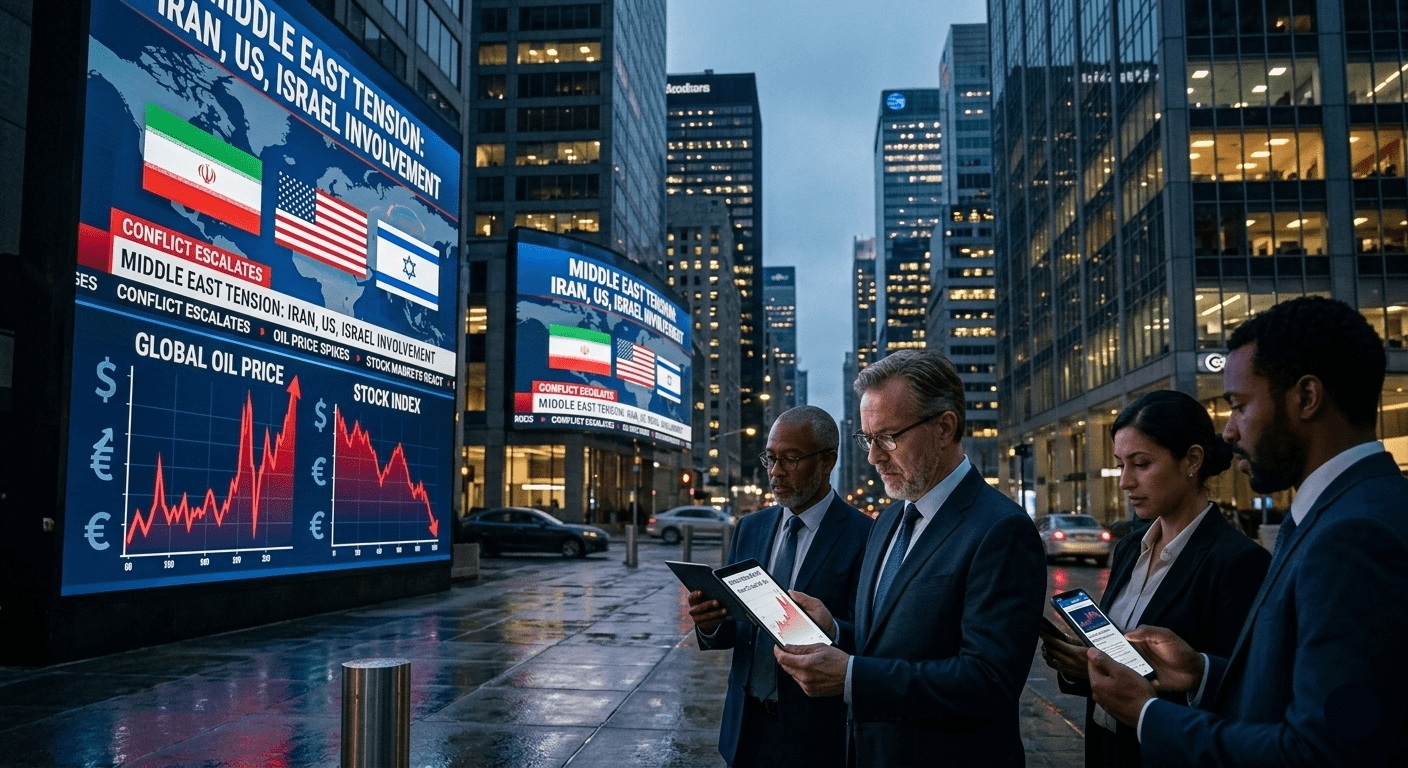
How the conflict is reshaping energy markets, international trade, investment decisions and the global economy
The conflict involving Iran, the United States and Israel has developed into one of the most consequential geopolitical and economic disruptions of 2026.
What initially appeared to be a regional military confrontation has become a global business problem. The effects are now visible in oil markets, international shipping, aviation, inflation, food prices, corporate investment and financial markets.
The most important economic pressure point remains the Strait of Hormuz. Disruption to this strategic waterway has affected the movement of oil and refined products from the Gulf, forcing businesses, governments and investors to reassess risks that many had previously considered manageable.
The International Monetary Fund has described the shock as one of the largest disruptions to the global oil market in decades. The global economy has proved more resilient than many initially feared, but the costs have been distributed unevenly and the risks of renewed escalation remain significant.
This article examines how the Iran-US-Israel conflict is affecting global business and what companies should do in response.
Key Economic Impacts at a Glance
| Area | Main Impact |
|---|---|
| Oil markets | Higher prices and increased volatility |
| Strait of Hormuz | Major disruption to energy and shipping flows |
| Global trade | Higher freight, insurance and logistics costs |
| Aviation | Flight disruption and higher fuel expenses |
| Inflation | Increased pressure from energy and transportation costs |
| Financial markets | Greater volatility and sector rotation |
| Emerging economies | Greater exposure to imported energy costs |
| Businesses | Higher geopolitical and supply chain risk |
Introduction: A Regional Conflict With Global Economic Consequences
Modern conflicts do not remain contained within national borders when they involve major energy producers, strategic shipping routes and global powers.
The Iran-US-Israel conflict demonstrates this clearly.
The Middle East remains central to the global energy system. The region supplies oil, refined petroleum products and natural gas to economies around the world. It is also home to shipping routes that connect the Gulf with Asia, Europe and other major markets.
As the conflict intensified, the Strait of Hormuz became one of the world’s most important economic pressure points. Before the conflict, the route carried an enormous volume of global energy supplies. The IMF estimated that the disruption effectively removed access to around 20 million barrels per day of crude oil and refined products moving through the waterway at the height of the crisis.
Recent data also shows that shipping activity remains significantly below normal levels, demonstrating that the economic consequences of the conflict have continued beyond the initial military shock.
For international businesses, this creates a new reality:
Geopolitical risk is no longer simply a political issue. It is an operational, financial and strategic business risk.
1. Oil Markets: The Fastest Global Transmission Channel
Oil prices are often the first major economic indicator to react when conflict threatens the Middle East.
That is because energy is embedded throughout the global economy.
Higher oil prices affect:
- Airlines
- Shipping companies
- Logistics providers
- Manufacturers
- Agricultural businesses
- Retailers
- Construction companies
- Consumers
The initial disruption pushed oil prices sharply higher. According to the IMF, crude prices later stabilized largely because of inventory drawdowns, increased production outside the Gulf and weaker demand caused by higher prices.
However, stabilization should not be confused with the end of the risk.
Recent renewed tensions have pushed oil prices higher again, with Brent crude moving back toward the mid-$90 range as markets responded to concerns about further supply disruption.
Why Oil Prices Affect Almost Every Business
Consider a relatively simple supply chain.
A manufacturer buys raw materials.
Those materials are transported by truck, ship or air.
The finished products are then delivered to warehouses and customers.
Every stage may depend directly or indirectly on energy.
When fuel costs rise:
- Transportation becomes more expensive.
- Suppliers may increase prices.
- Manufacturers face higher operating costs.
- Retailers experience increased distribution expenses.
- Consumers eventually pay more.
This is why an oil shock can eventually become an inflation problem.
The Problem of Persistent Volatility
For businesses, the biggest challenge is not necessarily a single high oil price.
It is uncertainty.
A company can plan around predictable costs. It becomes much harder to plan when energy prices can change significantly because of military escalation, shipping attacks or political decisions.
This uncertainty can delay:
- Factory expansion
- International investment
- New product launches
- Hiring decisions
- Capital expenditure
2. The Strait of Hormuz: The World’s Most Important Economic Chokepoint
The Strait of Hormuz is strategically important because it connects Gulf energy producers with international markets.
Its disruption therefore affects much more than Iran.
Saudi Arabia, Iraq, Kuwait, the United Arab Emirates and Qatar all depend to varying degrees on maritime infrastructure connected to the region.
The IMF described the disruption as historically significant. Alternative pipelines and export facilities have provided some relief, but they cannot fully replace the capacity of normal shipping through the Strait.
Recent shipping data shows that commercial traffic through the waterway remains substantially below normal levels.
Why Alternative Routes Cannot Fully Solve the Problem
Some Gulf producers can redirect part of their exports through pipelines or ports outside the Strait.
For example, alternative infrastructure can help move some oil toward the Red Sea or other export terminals.
But the capacity is limited.
That creates a fundamental problem:
The global energy system can adapt to a disruption, but it cannot instantly replace one of its most important transportation routes.
The longer disruption continues, the more pressure it places on:
- Global inventories
- Alternative energy supplies
- Shipping companies
- Insurance markets
- Consumers
The IMF warned that the oil market initially absorbed the shock by drawing on inventories and increasing production elsewhere, but those buffers are not unlimited.
3. Global Supply Chains Face a New Stress Test
The conflict has exposed how dependent global trade remains on a relatively small number of strategic routes.
Businesses already faced supply chain challenges from:
- Previous pandemic disruptions
- Red Sea insecurity
- The Russia-Ukraine war
- Trade tensions
- Changing tariff policies
The Iran conflict adds another major layer of uncertainty.
Maritime Shipping Costs Are Rising
Shipping companies operating near conflict zones face increased costs from:
- War-risk insurance
- Security measures
- Delays
- Route changes
- Higher fuel expenses
Even when a ship is physically capable of travelling through a region, the economics may no longer make sense.
Insurance coverage can become more expensive or restricted. Operators may delay voyages until conditions improve.
Recent attacks and security incidents involving commercial vessels have reinforced the risks facing shipping in the region.
The Red Sea Problem
Alternative routes are also not always secure.
When the Strait of Hormuz becomes difficult to use, businesses naturally look for other maritime routes.
However, instability in the Red Sea and Gulf of Aden creates additional complications.
This means companies may face a situation where multiple strategic routes carry elevated risk at the same time.
For global supply chains, that is a serious structural problem.
Which Businesses Are Most Exposed?
The most vulnerable companies are often those with:
- A single major supplier
- Limited inventory
- Heavy dependence on Gulf shipping
- High fuel consumption
- Complex international logistics
Small and medium-sized businesses may be particularly vulnerable because they often lack the financial resources to hedge energy prices or rapidly change suppliers.
4. Aviation and Tourism: A Direct Business Impact
The Middle East is one of the world’s most important aviation hubs.
Airports in the Gulf connect Europe, Asia, Africa and North America.
Military activity, airspace restrictions and security concerns can therefore create disruption far beyond the immediate conflict zone.
Airlines face several simultaneous problems:
- Cancelled flights
- Airspace closures
- Longer routes
- Higher jet fuel costs
- Increased insurance expenses
Aviation is especially sensitive to oil prices because fuel represents one of its largest operating costs.
When oil prices remain elevated, airlines may eventually face a choice between:
- Reducing margins
- Increasing ticket prices
- Cutting capacity
For international companies, aviation disruption also affects:
- Business travel
- Air freight
- Urgent cargo
- International meetings
The disruption therefore extends into global commerce.
5. Financial Markets: Why Investors Have Not Reacted Uniformly
One of the most interesting aspects of the conflict has been the difference between financial markets and the real economy.
Financial markets have experienced volatility, but major global equity markets have not necessarily collapsed.
This does not mean the war has had little economic impact.
Instead, the impact has been uneven.
Some sectors have benefited while others have suffered.
Recent analysis has highlighted this divide, with major investors benefiting from certain market opportunities while consumers and vulnerable economies face rising costs.
Potential Beneficiaries
Energy
Higher oil prices can improve revenue and margins for some energy producers.
Defence
Governments facing greater geopolitical insecurity may increase spending on:
- Military equipment
- Air defence
- Drones
- Cybersecurity
- Critical infrastructure
Energy Infrastructure
The conflict could accelerate investment in:
- Pipelines
- LNG facilities
- Strategic storage
- Alternative export routes
Sectors Under Pressure
Airlines
High fuel costs directly affect profitability.
Transportation and Logistics
Companies face higher operating and insurance costs.
Consumer Businesses
Consumers may reduce discretionary spending if food, fuel and transportation costs increase.
Energy-Intensive Manufacturing
Manufacturers that require significant energy inputs can face margin pressure.
6. Inflation: The War’s Most Important Economic Threat
The most serious long-term economic effect of the conflict may be inflation.
The IMF’s July 2026 update projected global growth of 3 percent for 2026 but increased its global headline inflation forecast to 4.7 percent, stating that the disinflation trend had stalled.
The conflict contributes to inflation through several channels.
Energy
Higher oil and gas prices affect transportation and industrial production.
Food
Agriculture depends heavily on fuel and fertilizer.
Manufacturing
Higher transportation and energy costs increase production expenses.
Consumer Spending
Businesses eventually pass some higher costs to customers.
This creates a difficult environment for central banks.
Central banks normally prefer to reduce interest rates when economic growth weakens.
But higher inflation can limit their ability to do so.
This creates a policy dilemma:
The economy may need lower interest rates to support growth while inflation may require tighter monetary policy.
That combination is particularly difficult for businesses dependent on affordable borrowing.
7. Emerging Economies Are More Vulnerable
The global economy does not experience energy shocks equally.
Countries that import large quantities of oil are generally more vulnerable than major energy exporters.
Lower-income economies may face particular difficulties because they often have:
- Limited foreign currency reserves
- Higher public debt
- Smaller financial buffers
- Greater dependence on imported energy
The IMF has warned that the effects of the conflict are uneven and that countries with limited policy space are particularly vulnerable.
Higher energy prices can affect:
- Government budgets
- Currency stability
- Inflation
- Current account balances
- Food security
This can create secondary risks for international investors and multinational companies operating in vulnerable markets.
8. Food, Fertilizer and Agriculture
Oil is not the only commodity affected by geopolitical disruption.
Natural gas and energy costs are important to fertilizer production.
Higher fertilizer costs can eventually affect agricultural output and food prices.
Recent reporting has highlighted rising fertilizer prices and the potential consequences for food security, particularly in developing economies.
The danger is that agricultural consequences can take longer to appear.
A fuel shock can affect prices immediately.
Reduced fertilizer use may affect future harvests.
That means the full economic consequences of an energy crisis may continue even after oil prices begin to fall.
9. How the Conflict Is Changing Global Investment
The conflict is likely to influence where companies invest.
Businesses making long-term international investments increasingly need to consider geopolitical resilience.
Previously, a company choosing a country for a factory may have focused primarily on:
- Labour costs
- Taxes
- Market access
- Infrastructure
Those factors remain important.
But geopolitical resilience is becoming a more significant part of the calculation.
Investors may increasingly ask:
- How secure are energy supplies?
- Are shipping routes reliable?
- Can the country withstand regional instability?
- Does the business have access to alternative suppliers?
- Is the banking system resilient?
- Are cross-border payments vulnerable to sanctions?
This could create opportunities for countries with:
- Diversified energy supplies
- Stable institutions
- Strong infrastructure
- Multiple trade connections
Capital Is Becoming More Selective
The conflict does not necessarily mean that global investment will decline across every sector.
Instead, investment may become more selective.
Companies may move toward jurisdictions that offer greater predictability and resilience.
This represents a significant shift.
Geopolitical stability is increasingly becoming part of the investment case.
10. The Impact on International Banking and Payments
International businesses should also consider financial infrastructure.
Geopolitical conflict can affect:
- Cross-border transfers
- Currency markets
- Sanctions compliance
- Banking relationships
- Trade finance
Companies with exposure to affected countries need to understand whether their banks, payment providers and suppliers could face:
- New sanctions
- Compliance restrictions
- Delayed transactions
- Currency volatility
Businesses should avoid assuming that their existing banking arrangements will automatically function normally during a geopolitical crisis.
A resilient international business should have clear contingency plans.
11. What Businesses Should Do Now
Businesses should not attempt to predict every military or political development.
That is impossible.
The objective should be to build resilience.
Review Your Supply Chain
Identify:
- Critical suppliers
- Shipping routes
- Ports
- Countries of origin
Ask whether a single disruption could stop operations.
Examine Energy Exposure
Businesses should understand how different oil and energy price scenarios affect:
- Operating costs
- Profit margins
- Pricing
Review Insurance
Check:
- Marine coverage
- Cargo coverage
- Political risk insurance
- Business interruption policies
Do not assume that all geopolitical risks are automatically covered.
Diversify Where Possible
Consider:
- Alternative suppliers
- Additional logistics routes
- Backup manufacturing locations
Diversification can be expensive, but complete dependence on one route can be even more expensive during a crisis.
Review Financial Exposure
Businesses operating internationally should assess:
- Currency risk
- Sanctions exposure
- Payment continuity
- Banking relationships
12. Three Economic Scenarios for the Future
Scenario 1: Gradual De-escalation
Under this scenario:
- Military activity decreases
- Shipping conditions gradually improve
- Energy exports recover
- Oil prices decline
This would be the most positive outcome for the global economy.
The IMF’s forecasts have generally assumed some normalization in the movement of energy through the region, although renewed escalation remains a significant downside risk.
Scenario 2: Prolonged Instability
Under this scenario:
- Periodic military escalation continues
- Shipping remains risky
- Oil prices stay elevated
- Investment decisions are delayed
This could produce a prolonged risk premium in energy and financial markets.
The greatest challenge would be uncertainty.
Businesses may continue operating, but at higher costs and with greater caution.
Scenario 3: Major Escalation
The most serious scenario would involve a significant worsening of the conflict and further disruption to energy infrastructure or international shipping.
This could lead to:
- Sharp oil price increases
- Higher global inflation
- Financial market volatility
- Greater pressure on vulnerable economies
The IMF has repeatedly warned that renewed escalation could tighten financial conditions, increase commodity volatility and worsen food insecurity.
Final Thoughts: Prepare for Uncertainty
The Iran-US-Israel conflict has reinforced an important lesson for the global business community.
Economic resilience can no longer be separated from geopolitical resilience.
The conflict has affected:
- Oil prices
- International shipping
- Aviation
- Supply chains
- Inflation
- Food markets
- Financial markets
- Foreign investment
The global economy has shown more resilience than many analysts initially expected. Inventories, increased production outside the Gulf and lower energy demand helped absorb the initial shock.
But the situation remains vulnerable.
Recent developments demonstrate that renewed military escalation can quickly push energy prices higher and disrupt already fragile shipping networks.
For businesses, the correct response is neither panic nor complacency.
It is preparation.
Companies should understand their exposure, diversify where practical and develop contingency plans for supply chains, energy costs, banking and international payments.
The businesses most likely to navigate this period successfully will not necessarily be those that correctly predict the next geopolitical development.
