


Introduction
A weak business description doesn’t just sound unprofessional—it can quietly reduce conversions, kill trust, and keep your brand invisible online. The problem? Most descriptions are rushed, unclear, or outdated.
With the right business description editing guidelines, you can transform a confusing paragraph into a powerful, search-friendly brand story that wins attention and drives results.
This guide shows you exactly how.
Quick Answer
Business description editing guidelines are a set of rules and best practices used to review, refine, and optimize a company’s description for clarity, accuracy, SEO, consistency, and brand voice. They help businesses communicate what they do, who they serve, and why they matter in a concise, credible, and user-focused way.
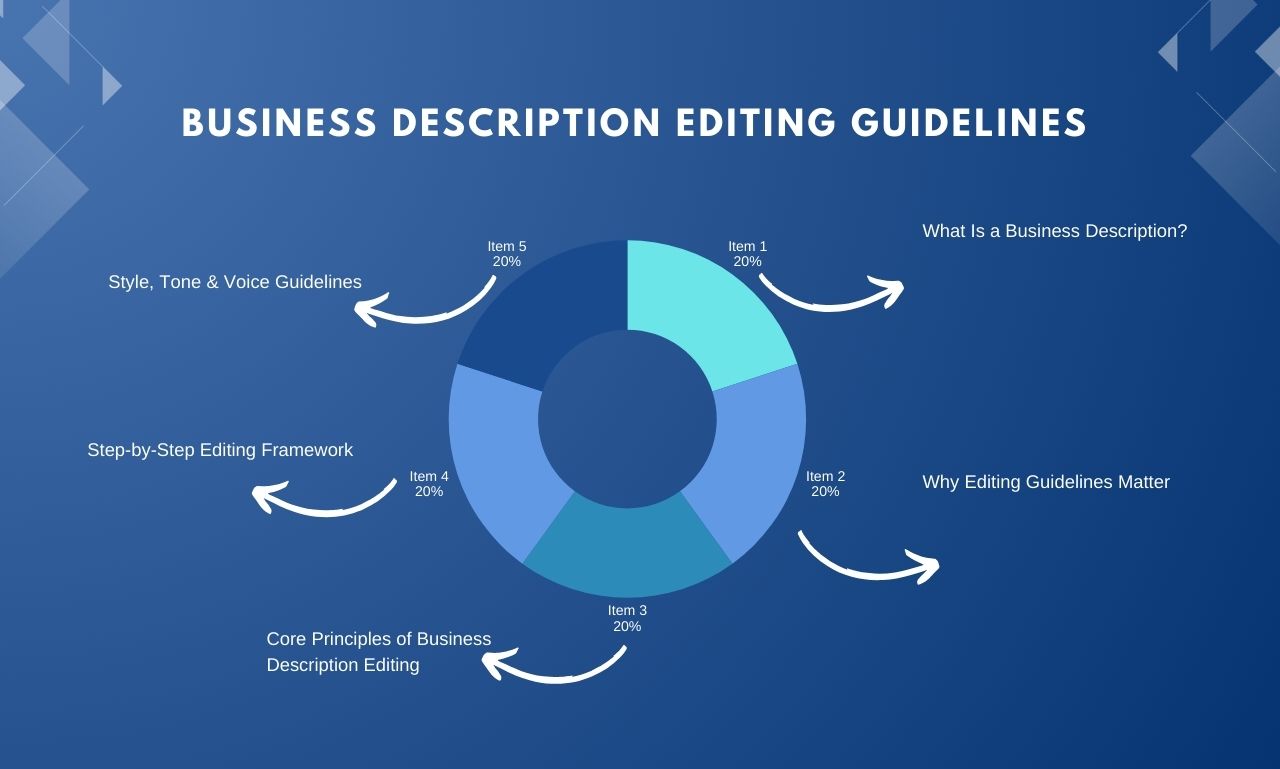
1. What Is a Business Description?
A business description is a concise explanation of what a company does, who it serves, and what makes it unique. It’s commonly used for:
- Websites and landing pages
- Business directories
- Social media profiles
- Pitch decks and proposals
- Investor materials
- Press kits
A clear description functions as the brand’s “elevator pitch” on paper.
2. Why Business Description Editing Guidelines Matter
Editing guidelines ensure your business description is:
- Accurate
- Easy to understand
- Keyword-optimized
- Consistent with brand voice
- Compelling to readers
- Relevant to AI Overviews and search engines
In today’s environment—where users skim, and algorithms evaluate clarity—polished descriptions create a major competitive advantage.
3. Core Principles of Business Description Editing
3.1 Clarity Comes First
Your description should be understood in one read. Avoid jargon, overly complex sentences, and vague claims.
Good: “We help small businesses automate their accounting tasks.”
Bad: “We leverage innovative fintech methodologies to streamline fiscal workflows.”
3.2 Accuracy Matters
Check for outdated details such as:
- Old pricing
- Discontinued services
- Outdated locations
- Incorrect company size
- Old certifications or awards
3.3 Consistent Brand Voice
Your tone should reflect your brand:
- Professional
- Friendly
- Luxury
- Technical
- Minimalist
3.4 User-First, Not Company-First
Focus on benefits, not bragging.
Company-first: “We are the best digital agency.”
User-first: “We help brands grow faster through data-driven marketing.”
3.5 SEO-Friendly Without Keyword Stuffing
Use keywords naturally. Include:
- Industry terms
- Locality (if relevant)
- Service categories
3.6 AI-Readable Formatting
AI search systems prefer descriptions that are:
- Structured
- Explicit
- Easy to extract
- Fact-focused
4. Step-by-Step Business Description Editing Framework
This framework is optimized for human readability, search engine understanding, and AI Overview extraction.
Step 1: Identify the Purpose
Ask:
Where will this description be used, and who will read it?
Different contexts require different lengths:
- Social bio: 1–2 sentences
- Google Business Profile: 750 characters
- Website About section: 150–300 words
Step 2: Clarify the Core Message
Highlight three essentials:
- What you do
- Who you help
- Why it matters
Example:
“We provide IT support for healthcare organizations to help them reduce downtime and improve patient data security.”
Step 3: Organize Information Logically
A proven structure:
- Opening statement
- Core products/services
- Unique value proposition
- Social proof (optional)
- CTA or positioning line
Step 4: Strengthen the Language
Focus on:
- Strong verbs
- Specific claims
- Concrete examples
Replace weak adjectives with facts.
Step 5: Remove Confusion
Cut:
- Jargon
- Redundant phrases
- Unnecessary history
- Buzzwords
Example: Replace “innovative” with a real example of innovation.
Step 6: Enhance Credibility
Add evidence:
- Years in business
- Customer volume
- Certifications
- Awards
- Guarantees
Example:
“Trusted by 2,000+ e-commerce brands across the US.”
Step 7: Apply SEO Optimization
Use:
- Primary keyword once
- 1–3 semantic variations
- Industry terms
- Local geography if relevant
Step 8: Format for Skimmability
Users skim. Engines extract.
Use:
- Short sentences
- Short paragraphs
- Bullets
- Bold key phrases
Step 9: Final Polishing
Check for:
- Grammar
- Readability (Grade 6–8)
- Consistency
- Accuracy
- Brand alignment
5. Style, Tone & Voice Guidelines
5.1 Keep It Short and Direct
Aim for:
- Social bios: 20–30 words
- Directory listings: 50–70 words
- Website descriptions: 100–200 words
5.2 Use Plain Language
Replace complex words with simple ones.
Instead of: Utilize
Use: Use
5.3 Choose the Right Voice
Professional Example
“We provide compliance consulting for financial institutions.”
Friendly Example
“We help small businesses stay compliant without the stress.”
Premium Brand Example
“Our services are designed for organizations that expect precision, discretion, and excellence.”
6. SEO & GEO Optimization Tips
6.1 Use Entity-Rich Language
Include items like:
- Industries
- Tools
- Services
- Locations
- Business types
The more specific the content, the stronger the signal.
6.2 Balanced Keyword Strategy
Use the primary keyword early, then sprinkle related terms such as:
- business description best practices
- editing steps
- how to edit a company description
- description writing guidelines
6.3 AI Overview Optimization (GEO)
To increase inclusion in AI Assistant Answers:
- Provide explicit definitions
- Use structured lists
- Emphasize facts and clarity
- Avoid fluff
- Write short, high-value sentences
7. Common Mistakes to Avoid
- Writing too much history
- Using corporate jargon
- Making vague claims like “industry-leading”
- Not mentioning who you serve
- Ignoring SEO
- Using long paragraphs
- Forgetting to update outdated details
- Sounding robotic or generic
8. Examples of Strong vs. Weak Business Descriptions
Weak Example
“ABC Solutions is a company that provides various services to help businesses grow with innovative strategies and modern tools.”
What’s wrong?
- Vague
- No audience
- Buzzwords
- No proof
Strong Example
“ABC Solutions helps small and mid-size retailers increase sales through data-driven marketing, conversion optimization, and automated customer retention tools. We’ve supported more than 1,500 brands across the US and offer month-to-month plans with no long-term commitment.”
Why it works?
- Specific
- Benefit-oriented
- Credible
- Clear value
- Strong proof
9. Business Description Editing Checklist
Copy and use:
- Clear purpose identified
- Audience defined
- Simple, plain language
- Accurate business facts
- Strong opening sentence
- Unique value proposition
- Specific services listed
- Credibility elements included
- SEO keywords added naturally
- Jargon removed
- Short paragraphs
- Final grammar check done
10. Frequently Asked Questions
What is the purpose of editing a business description?
Editing improves clarity, professionalism, SEO, and user understanding. It ensures your message is sharp, accurate, and compelling.
How long should a business description be?
Short bios: 20–30 words
Listing descriptions: 50–70 words
Website descriptions: 100–200+ words depending on context.
What should every business description include?
What you do, who you help, why you’re different, and proof of credibility.
How often should it be updated?
Review every 6–12 months or whenever services, policies, or milestones change.
Conclusion
Strong business description editing guidelines give you the structure and clarity needed to communicate your value instantly—whether your audience is a potential customer, an investor, or an AI search engine.
By following the steps in this guide, you’ll create descriptions that feel polished, trustworthy, and conversion-ready.
