


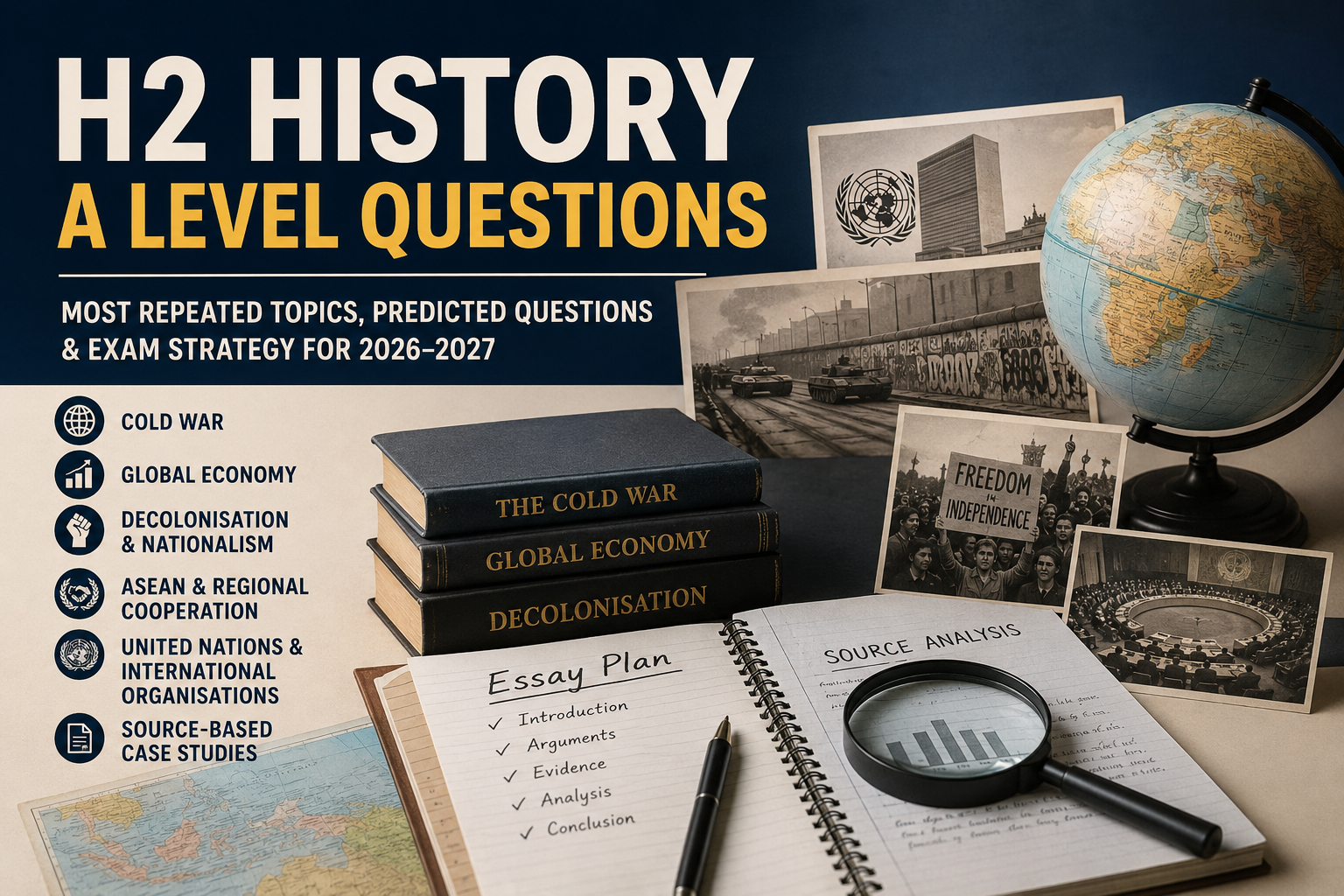
Across recent years, H2 History examinations have consistently focused on themes that require students to evaluate historical arguments rather than simply recall events. Examiners regularly revisit broad concepts from different perspectives instead of repeating identical questions.
The most frequently assessed areas include:
| Rank | Topic | Frequency |
| ★★★★★ | Cold War | Very High |
| ★★★★★ | Global Economy | Very High |
| ★★★★★ | United Nations | Very High |
| ★★★★★ | Decolonisation & Nationalism | Very High |
| ★★★★☆ | ASEAN | High |
| ★★★★☆ | Asian Tigers | High |
| ★★★★☆ | Superpower Relations | High |
| ★★★★☆ | Economic Globalisation | High |
| ★★★★☆ | International Institutions | High |
| ★★★☆☆ | Regional Conflicts | Medium |
Cold War Questions That Appear Repeatedly
The Cold War remains one of the most examined topics because it offers numerous opportunities for evaluating causes, leadership, ideology, diplomacy, and international relations.
Frequently Tested Themes
- Origins of the Cold War
- Responsibility for Cold War tensions
- Containment policy
- Truman Doctrine
- Marshall Plan
- Berlin Crisis
- Cuban Missile Crisis
- Vietnam War
- Sino-Soviet Split
- Détente
- Reagan’s foreign policy
- Collapse of the Soviet Union
- Gorbachev’s reforms
- End of the Cold War
Common Essay Styles
- To what extent…
- How far do you agree…
- Assess the importance…
- Evaluate the effectiveness…
- Was…the main reason…
High-Frequency Examples
- To what extent was ideology responsible for the Cold War?
- Assess the importance of the Cuban Missile Crisis.
- Was containment successful?
- Why did détente fail?
- Evaluate the role of Gorbachev in ending the Cold War.
- Was Reagan responsible for the collapse of the Soviet Union?
Global Economy Questions Examiners Revisit
Economic history has become increasingly important because it connects politics with globalization.
Frequently tested themes include:
- Bretton Woods System
- IMF
- World Bank
- GATT
- WTO
- Economic globalization
- Asian Financial Crisis
- Global recession
- Free trade
- Protectionism
Common essay angles include:
- Success of globalization
- International cooperation
- Impact of free trade
- Economic crises
- Role of international organizations
Recurring examples:
- Assess the effectiveness of the IMF.
- How successful has the WTO been?
- Was globalization beneficial for developing countries?
- Evaluate the Bretton Woods system.
- To what extent has free trade promoted economic growth?
Decolonisation and Nationalism Essay Trends
Examiners often compare different independence movements instead of asking purely factual questions.
Major themes include:
- British decolonisation
- French decolonisation
- Nationalism
- Independence movements
- Colonial policies
- Self-determination
- Political leadership
Frequently examined countries
- India
- Malaya
- Indonesia
- Vietnam
- Algeria
Common question styles
- Compare nationalist movements.
- Assess colonial policies.
- Evaluate leadership.
- Explain why independence movements succeeded.
Recurring examples
- Why was nationalism successful?
- Compare independence movements in Asia.
- To what extent did colonial policies accelerate independence?
- Evaluate the importance of political leadership.
ASEAN and Regional Cooperation Questions
ASEAN continues to receive regular attention because regional cooperation remains a major syllabus theme.
Frequently examined topics
- ASEAN formation
- ASEAN objectives
- Economic cooperation
- Political cooperation
- Regional stability
- Security cooperation
- ASEAN expansion
Essay trends
- Has ASEAN been successful?
- Economic versus political achievements
- Regional peace
- ASEAN’s limitations
Examples
- Assess ASEAN’s contribution to regional stability.
- Evaluate ASEAN’s economic achievements.
- Has ASEAN remained relevant?
United Nations and International Organisations
International organizations frequently appear because they connect Cold War, globalization, and peacekeeping.
Popular themes include
- UN peacekeeping
- Security Council
- Collective security
- Humanitarian intervention
- International law
- UN successes
- UN failures
Frequently asked styles
- Evaluate effectiveness.
- Assess limitations.
- Compare with other organizations.
Typical examples
- Has the United Nations maintained international peace?
- Evaluate UN peacekeeping operations.
- Why has collective security been difficult to achieve?
Source-Based Case Study (SBCS) Recurring Themes
Source-Based Questions generally focus on interpretation rather than factual recall.
Popular themes include
Cold War
- Superpower rivalry
- Containment
- Cuban Missile Crisis
- Berlin Crisis
Global Economy
- WTO
- IMF
- Globalization
- Trade disputes
United Nations
- Peacekeeping
- Security Council
- Humanitarian intervention
ASEAN
- Regional cooperation
- Security
- Economic integration
Students should practise:
- Source comparison
- Reliability
- Utility
- Cross-reference
- Historical context
35 Predicted Practice Questions for 2026–2027
These are informed practice predictions based on recurring syllabus themes and historical assessment patterns. They are not official exam questions.
Cold War
- To what extent was ideology responsible for the Cold War?
- Evaluate the effectiveness of containment.
- Was the Cuban Missile Crisis the turning point of the Cold War?
- Why did détente collapse?
- Assess Reagan’s contribution to ending the Cold War.
- Evaluate Gorbachev’s reforms.
- Was economic weakness the main reason for Soviet collapse?
- Compare Truman and Reagan’s foreign policies.
- Assess the importance of the Berlin Crisis.
- Why did the Cold War remain peaceful in Europe?
Global Economy
- Assess the effectiveness of the IMF.
- Has globalization benefited developing countries?
- Evaluate the Bretton Woods system.
- Was the WTO successful?
- Compare free trade and protectionism.
- Explain the causes of major global financial crises.
- Evaluate international economic cooperation.
ASEAN
- Has ASEAN achieved its objectives?
- Assess ASEAN’s contribution to regional peace.
- Evaluate ASEAN economic cooperation.
- Compare ASEAN before and after expansion.
- Has ASEAN remained relevant?
United Nations
- Evaluate UN peacekeeping.
- Has collective security succeeded?
- Why has the Security Council faced criticism?
- Assess UN humanitarian intervention.
- Compare UN successes and failures.
Decolonisation
- Why did nationalism succeed?
- Compare two independence movements.
- Evaluate colonial policy.
- Assess leadership in decolonisation.
- Was external support important?
Comparative Essays
- Compare Cold War diplomacy and détente.
- Compare ASEAN and the United Nations.
- Compare globalization with regionalization.
How Do Examiners Rotate Topics?
While there is no fixed rotation, examiner patterns often show that:
- Broad syllabus areas reappear regularly.
- The same theme is usually tested through a different angle rather than repeating identical wording.
- Essays alternate between:
- Causes
- Consequences
- Successes
- Failures
- Comparisons
- Evaluations
- Source-Based Case Studies often revisit familiar events using different source sets.
This means students should prepare for themes, not memorize predicted questions.
Topics That Have Not Appeared Recently (Revise with Caution)
Based on historical patterns, some areas may deserve additional attention if they have received comparatively less emphasis in recent papers. This does not mean they are due—exam boards are free to assess any syllabus content.
Potential revision priorities include:
- Lesser-emphasized ASEAN institutional developments.
- Comparative questions involving international organizations.
- Long-term impacts of economic globalization on developing states.
- The role of middle powers in the Cold War.
- Alternative explanations for the end of the Cold War beyond leadership.
- Comparative decolonisation case studies outside the most commonly discussed examples.
Treat these as areas to strengthen, not predictions.
Final Weeks Study Strategy
Week 1
- Review complete syllabus
- Build timeline notes
- Memorize key dates
Week 2
- Practice essay plans
- Review examiner reports
- Complete source analysis exercises
Week 3
- Write timed essays
- Practice SBCS under exam conditions
- Review weaker topics
Final Week
- Revise evidence banks
- Review model introductions and conclusions
- Focus on analysis rather than new content
- Sleep well and practise time management
Aim to answer at least:
- 20–30 essay questions (planned or written)
- 10–15 full Source-Based Case Studies
- Multiple timed papers before the examination.
Frequently Asked Questions
Q: Which H2 History topic appears most often?
A: The Cold War is generally the most consistently examined theme, followed closely by the Global Economy, the United Nations, Decolonisation, and ASEAN. However, every examinable topic remains a possible assessment area.
Q: Can predicted questions accurately forecast the exam?
A: No. Predictions help prioritize revision by highlighting recurring themes, but they cannot guarantee what will appear. Use them alongside comprehensive study of the full syllabus.
Q: How many essay questions should I practise?
A: A strong target is to plan or write 20–30 essays and complete 10–15 Source-Based Case Studies before the exam. Focus on quality analysis and feedback, not just quantity.
Q: What do examiners value most?
A: Examiners consistently reward clear arguments, balanced evaluation, accurate historical evidence, and a well-supported judgement that directly addresses the question.
Q: Is memorising facts enough to score well?
A: No. Strong factual knowledge is essential, but top marks depend on using those facts to analyse, compare, and evaluate historical issues rather than simply describing events.
Disclaimer: These questions are predictions based on recurring themes, syllabus coverage, examiner reports, and topic rotation patterns. They are not leaked exam questions and there is no guarantee they will appear in future examinations. Always revise the entire syllabus.
