


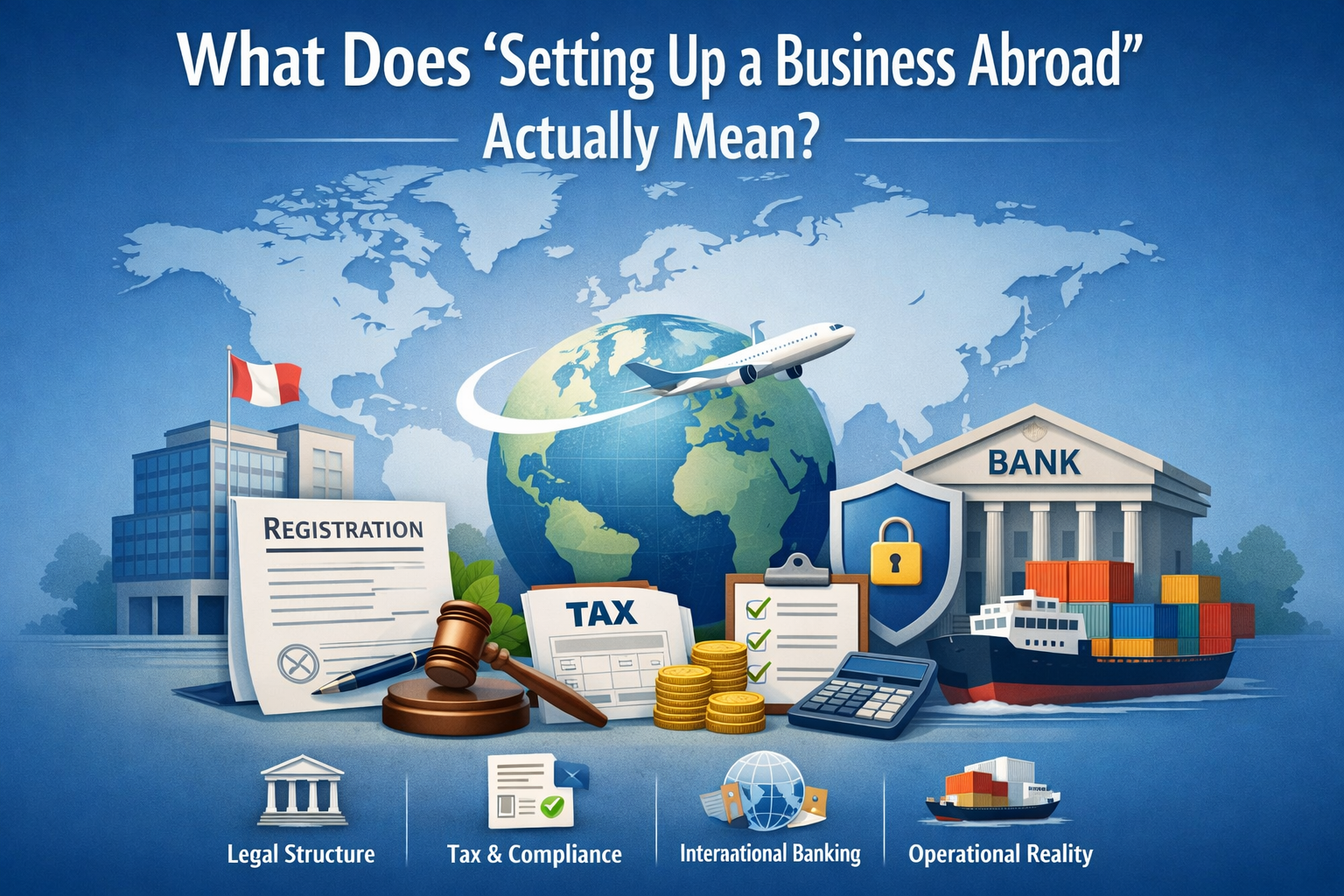
Setting up a business abroad is often described as a single action, but in practice it refers to a set of legal, operational, tax, and compliance decisions that allow a business to operate outside its home jurisdiction.
The term is frequently misunderstood. It does not simply mean registering a company in another country, nor does it automatically result in tax advantages, operational flexibility, or banking access. In many cases, establishing a business presence abroad introduces additional obligations and risks that must be understood before any formal steps are taken.
This article explains what “setting up a business abroad” actually involves, the contexts in which it is commonly used, and the considerations that shape international business structures.
Understanding the Core Concept
At its most basic level, setting up a business abroad means creating a legally recognised business presence in a foreign jurisdiction.
That presence may take different forms, depending on the purpose of the activity, the regulatory environment, and how the business is managed. Importantly, the existence of a foreign entity or registration does not operate in isolation — it interacts with tax law, banking rules, reporting requirements, and international compliance frameworks.
In practical terms, setting up a business abroad usually involves:
- Establishing a legal structure recognised by local law
- Determining where management and control occur
- Complying with local and international tax obligations
- Meeting regulatory, reporting, and substance requirements
- Maintaining access to banking and payment infrastructure
Each of these elements carries independent consequences. Ignoring one often undermines the entire structure.
Legal Presence vs. Operational Presence
One of the most common misunderstandings is assuming that legal registration alone equals operational reality.
A company may be legally incorporated in one country while its actual operations, decision-making, and economic activity occur elsewhere. In such cases, regulators and tax authorities may look beyond formal registration and assess where the business is effectively managed and operated.
This distinction matters because many obligations — particularly tax and reporting obligations — are based not only on incorporation, but also on:
- Place of management and control
- Location of directors and decision-makers
- Where contracts are negotiated and executed
- Where employees or key assets are located
Setting up a business abroad therefore requires aligning legal form with operational substance, rather than treating incorporation as a standalone solution.
Common Reasons Businesses Establish Foreign Structures
Businesses establish operations abroad for a variety of legitimate reasons. These reasons differ significantly depending on industry, scale, and risk tolerance.
Common drivers include:
- Expanding into new markets
- Structuring international group operations
- Managing cross-border suppliers or customers
- Separating regional activities for regulatory or commercial reasons
- Supporting international payment and banking requirements
While tax considerations often form part of the discussion, they are rarely the only or primary factor in sustainable international structures. In many cases, regulatory clarity, operational efficiency, and banking access are equally important.
Structural Choices and Their Implications
“Setting up a business abroad” does not describe a single structure. Businesses may establish foreign operations using different legal forms, each with distinct implications.
These may include:
- Separate legal entities (such as subsidiaries)
- Branches or permanent establishments
- Holding or intermediate companies
- Representative or liaison offices
The choice of structure affects:
- Liability exposure
- Tax treatment
- Reporting requirements
- Banking relationships
- Ongoing compliance costs
Selecting an inappropriate structure can create long-term issues that are difficult to unwind later.
Tax and Compliance Considerations
International business structures operate within overlapping tax and regulatory systems. Establishing a business abroad can trigger obligations in more than one jurisdiction simultaneously.
Common areas of consideration include:
- Corporate tax exposure
- Withholding taxes
- Transfer pricing and intercompany transactions
- Reporting and disclosure requirements
- Economic substance and transparency rules
Crucially, compliance obligations do not stop at the border. Businesses operating internationally are increasingly subject to information sharing between tax authorities and regulators.
Understanding these dynamics is essential before any foreign structure is established.
Banking and Operational Reality
A foreign business structure is only functional if it can operate day to day. In practice, this means maintaining access to banking, payment systems, and financial infrastructure.
International banks assess businesses based on:
- Ownership and control
- Jurisdictional risk
- Transparency and documentation
- Nature of activities
- Compliance history
As a result, setting up a business abroad often involves aligning legal, tax, and operational decisions with banking requirements from the outset. Structures that appear acceptable on paper may face difficulties in practice if they do not meet financial institutions’ expectations.
Common Misunderstandings
Several persistent misconceptions surround the idea of setting up a business abroad:
- That incorporation alone determines tax outcomes
- That foreign entities automatically reduce complexity
- That banking access is guaranteed once a company is formed
- That compliance obligations are lighter outside one’s home country
In reality, international business structures are often more regulated, not less. Successful setups are typically conservative, well-documented, and aligned with commercial reality.
How This Fits Into International Business Operations
Setting up a business abroad should be viewed as part of a broader international operating framework rather than a one-off action.
It interacts directly with:
- International tax obligations
- Ongoing compliance and reporting
- Cross-border banking and payments
- Risk management and governance
Businesses that treat foreign structures as isolated tools often encounter operational or regulatory challenges later. Those that integrate structure, compliance, and operations from the start tend to achieve more sustainable outcomes.
Conclusion
Setting up a business abroad is not a single step or shortcut. It is a structural decision involving legal, tax, compliance, and operational considerations that extend beyond simple registration.
Understanding what the term actually means — and what it does not mean — is essential before engaging with international business structures. Clear definitions, realistic expectations, and alignment with regulatory and operational realities form the foundation of any effective international setup.
Disclaimer
This article is provided for general informational purposes only and does not constitute legal, tax, or financial advice.
