


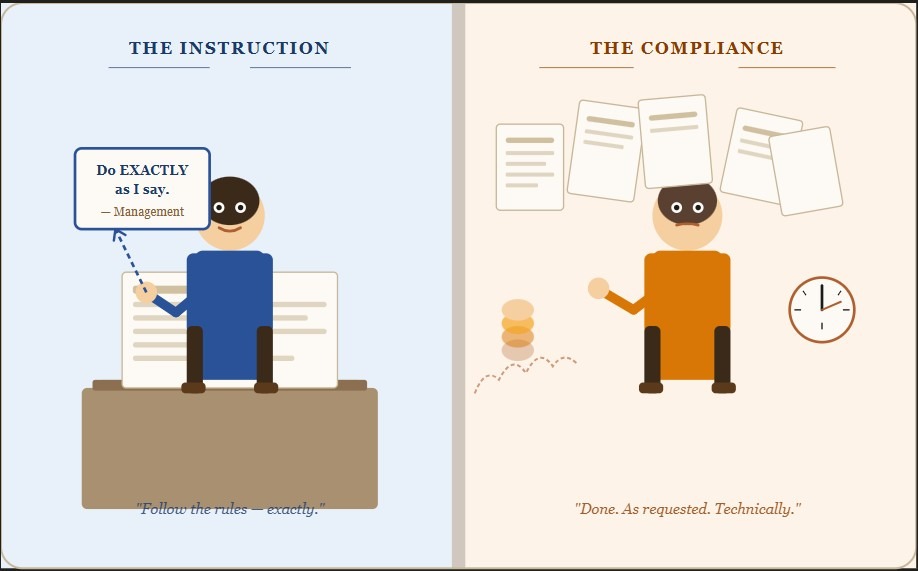
That’s malicious compliance in action. It’s one of the most misunderstood workplace behaviors, often dismissed as pettiness or insubordination. But it’s actually a signal — a symptom of something deeper going on in a team, a policy, or a relationship.
Whether you’re a manager trying to understand why an employee followed your instructions to disastrous effect, or an employee wondering if what you did crosses a line, this guide breaks it all down — clearly, practically, and without the usual corporate fluff.
Quick answer
Malicious compliance is the act of following a rule, instruction, or policy exactly as stated — while deliberately ignoring its intended purpose. The result technically satisfies the requirement, but often causes problems. It typically signals frustration, poor communication, or distrust between employees and leadership.
Table of Contents
What is malicious compliance?
Malicious compliance is the deliberate act of adhering strictly to the letter of a rule, order, or instruction — while intentionally disregarding its spirit or underlying purpose. The person complying knows their action technically satisfies what was asked, but also knows — or expects — it will cause problems, waste, or embarrassment.
The word “malicious” here doesn’t always mean cruel or harmful in a criminal sense. It more often reflects intent: the person is not acting in good faith. They’re using the rule as a weapon.
Think of it as a form of passive resistance wrapped in a technically correct action.
Key distinction
Malicious compliance vs. strict compliance: Strict compliance means following rules carefully, without bad intent. Malicious compliance involves knowing the outcome will be problematic — and doing it anyway. The intent is what separates the two.
How malicious compliance actually works
Malicious compliance operates in a gap — the space between what someone said and what they meant. The bigger that gap, the more room there is to exploit it.
Here’s the general pattern:
- A rule or instruction is issued — often poorly worded, vague, or perceived as unreasonable.
- The recipient feels frustrated — but feels unable or unwilling to push back openly.
- They comply literally — doing exactly what was said, often to an extreme.
- The outcome backfires — the rule achieves something other than its intended goal.
- The complier maintains plausible deniability — “I did exactly what you asked.”
This last point is crucial. Malicious compliance gives the person a shield: they can’t be directly accused of disobedience because, on the surface, they complied.
Real-world examples of malicious compliance
Abstract definitions only go so far. Here are concrete, recognizable examples across different contexts.
Workplace
The overtime directive: A manager tells the team to “make sure every task on the list gets done before you leave.” Frustrated employees take this literally and stay until 2 a.m. completing low-priority items — racking up overtime costs and disrupting the next day’s schedule. They followed instructions. Technically.
Government / Policy
The speed limit protest: When authorities in certain countries set very low speed limits on contested roads, drivers comply — driving at exactly the limit, creating massive slowdowns and public frustration. They’re not speeding. But they’re making a point.
Customer service
The refund policy loophole: A company states “no refunds after 30 days.” A customer submits a return request on day 29, includes every original piece of packaging, all accessories, and a written receipt — for a product clearly used for weeks. They followed the policy to the letter.
Management
The report requirement: A new executive requires daily written reports from all teams to “improve visibility.” Teams begin submitting 40-page documents filled with granular, low-value data — technically meeting the request, but making the reports unreadable and the executive’s inbox unmanageable.
Each example shares the same DNA: the letter of the rule was followed, but its purpose was subverted — often with calculated precision.
Why do people engage in malicious compliance?
Malicious compliance doesn’t emerge out of nowhere. It’s almost always a response to something — a perceived injustice, a communication failure, or a culture problem.
1. Feeling unheard or dismissed
When employees raise legitimate concerns about a policy or instruction and get ignored, malicious compliance can become the only form of pushback available. It’s an indirect expression of “I told you this wouldn’t work.”
2. Poorly written or vague rules
Ambiguous instructions invite exploitation. If a rule has a gap, someone who’s frustrated will find it. Clear, well-reasoned policies significantly reduce the opportunity for malicious compliance to occur.
3. Low trust and low psychological safety
In environments where speaking up feels risky, people may resort to compliance as protest. They can’t say “this policy is wrong” — so they demonstrate it through action, with deniability intact.
4. Perceived unfairness or hypocrisy
If people see rules applied inconsistently — or see leadership break the same rules they enforce — malicious compliance can feel like a reasonable response. It’s a form of holding the system accountable to its own stated standards.
5. Power imbalance
When someone has little formal power but a strong incentive to resist, malicious compliance is one of the few tools available. It’s compliant enough to avoid punishment, but resistant enough to make a point.
Malicious compliance in the workplace: what managers need to know
For leaders and managers, malicious compliance is worth taking seriously — not because it’s always catastrophic, but because it’s almost always a warning sign.
How to recognize it
Malicious compliance can be hard to spot because it’s disguised as obedience. Look for these patterns:
- Outcomes that technically meet requirements but clearly miss the point
- An employee who follows instructions but offers no judgment, initiative, or flags
- Surprising or disproportionate results from simple requests
- A pattern of literal interpretation with someone who used to show more initiative
What it costs organizations
The impact of malicious compliance in organizational settings goes beyond the immediate outcome:
- Productivity loss — time and resources spent on technically-compliant but purposeless work
- Damaged trust — repeated incidents corrode team cohesion and manager-employee relationships
- Morale erosion — other team members observe the dynamic and draw conclusions about leadership quality
- Culture degradation — when malicious compliance becomes normalized, initiative and good faith erode across the board
| Behavior | Malicious compliance | Good-faith compliance |
| Intent | Follow the rule to expose its flaw | Follow the rule to achieve its goal |
| Communication | No flags raised despite knowing issues exist | Raises concerns proactively |
| Outcome | Technically correct, practically harmful | Aligned with intended purpose |
| Accountability | Deflected — “I did what you said” | Shared — “I thought this was the right approach” |
| Signal for leaders | Distrust, frustration, disengagement | Healthy working relationship |
Is malicious compliance legal?
This is a question that comes up more often than you’d expect — particularly in employment and contract law contexts.
In most cases, malicious compliance is not illegal. Following the explicit terms of an instruction, contract, or policy — even while knowing it will produce an unintended result — is generally not a legal violation.
However, there are exceptions worth noting:
- Employment law: If malicious compliance results in deliberate harm to a business, repeated instances could form the basis for a performance or conduct conversation — and in severe cases, disciplinary action. That said, it’s rarely straightforward, because the employee can point to their compliance.
- Contract law: Many contracts include a good faith and fair dealing clause, which can be invoked when one party technically complies but acts in a way that undermines the contract’s purpose.
- Workplace safety: If malicious compliance creates a safety hazard — for example, following a technically correct procedure that puts others at risk — it can cross into legal liability.
Legal note
This article provides general information, not legal advice. If you’re dealing with a situation involving potential legal exposure, consult a qualified employment attorney in your jurisdiction.
How to prevent malicious compliance (for managers and organizations)
Prevention is far more effective than damage control. The good news is that the conditions that produce malicious compliance are largely addressable.
1. Write instructions with intent, not just specifics
Don’t just say what to do — say why. When people understand the purpose behind a rule, they’re better equipped to apply good judgment. “Submit daily reports so we can identify blockers early” is harder to exploit than “submit daily reports.”
2. Build psychological safety into team culture
If people feel safe raising concerns without fear of retaliation, they’re far less likely to resort to indirect protest. Regular feedback channels, one-on-ones, and a culture that genuinely welcomes “have you considered…” conversations reduce the conditions for malicious compliance.
3. Acknowledge and revise flawed policies
When an employee points out a gap in a rule, and that gap is later exploited, the failure is as much on the policy as on the person. Leaders who respond defensively reinforce the cycle. Revisiting and updating policies based on real-world outcomes signals that leadership is paying attention.
4. Don’t mistake compliance for engagement
A team that follows every instruction to the letter without question isn’t necessarily a high-functioning team. Genuine engagement involves judgment, initiative, and occasional pushback. If those are absent, something is wrong — and malicious compliance may already be happening beneath the surface.
5. Address the relationship, not just the incident
When malicious compliance does occur, the instinct to punish is understandable but often counterproductive. The more effective response is to ask: what’s broken in this working relationship that led here? A direct, private conversation about frustrations and expectations usually does more than a disciplinary write-up.
Frequently asked questions
What is a simple definition of malicious compliance?
Malicious compliance means following a rule or instruction exactly as stated, while knowingly ignoring its intended purpose. The action is technically correct but practically harmful or counterproductive.
Is malicious compliance a form of insubordination?
Not directly. Insubordination involves openly refusing to follow instructions. Malicious compliance involves following them — which is why it’s harder to address. However, depending on the severity and intent, it may be treated as a conduct issue in some workplaces.
Can malicious compliance ever be justified?
Opinions vary. Some argue it’s a legitimate form of protest against unreasonable rules — especially when other avenues for feedback have been ignored. Others view it as a breach of professional good faith. Context matters: exposing a genuinely harmful or absurd policy is different from petty retaliation.
How is malicious compliance different from work-to-rule?
Work-to-rule is a specific form of collective action — usually during labor disputes — where employees do exactly what their contract requires and nothing more. It’s typically organized and public. Malicious compliance is usually individual, informal, and less openly declared.
What should a manager do if they suspect malicious compliance?
Start with a direct, non-accusatory conversation. Ask about the employee’s understanding of the goal behind the instruction. Focus on the outcome and the relationship, not the accusation. Addressing the underlying frustration is usually more productive than treating it as a disciplinary matter.
Does malicious compliance appear in popular culture?
Yes — there’s an entire online community dedicated to it (r/MaliciousCompliance on Reddit, with millions of members) where people share stories of following instructions to the letter with unintended consequences. The community highlights both humorous and genuinely insightful examples of the phenomenon in everyday life.
Conclusion
Malicious compliance is rarely just about someone following instructions badly. At its core, it’s a communication problem — a sign that something in the relationship between a rule and the people expected to follow it has broken down.
For managers and leaders, it’s a diagnostic signal worth taking seriously. For employees, it’s worth recognizing that while it can feel satisfying in the short term, it rarely fixes the underlying problem.
The clearest path forward — whether you’re on the giving or receiving end — is better communication, clearer intent, and a workplace culture where concerns can be raised without consequences.
When the gap between what’s said and what’s meant closes, malicious compliance loses the space it needs to operate.
Want to go deeper on workplace behavior and culture?
Explore related topics: psychological safety, work-to-rule, employee disengagement, and organizational communication — or share this article with someone navigating a tough workplace dynamic.
