


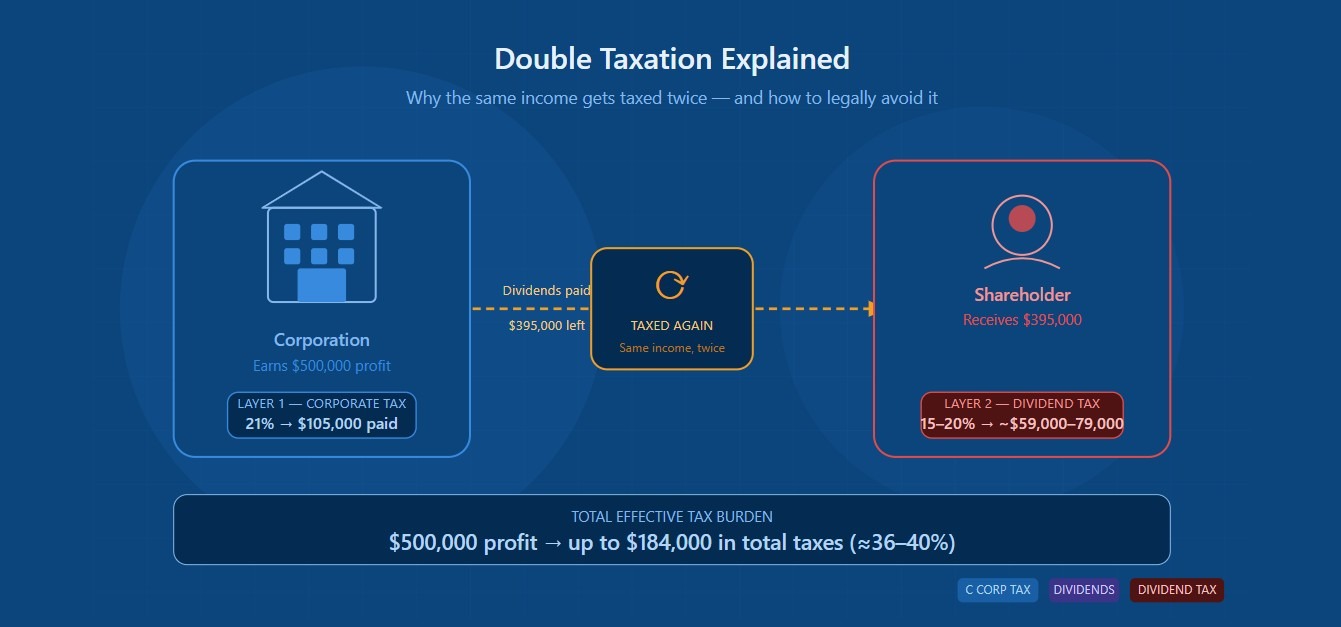
Double taxation occurs when the same income is taxed twice — once at the corporate level and again when shareholders receive dividends. It primarily affects C corporations in the U.S. Businesses can legally avoid it by electing S corp status, forming an LLC, or using pass-through taxation structures that report income directly on personal returns.
You built a profitable business. Then you watch the government take a cut at the corporate level — and again when you pull money out as a dividend. That’s double taxation, and it quietly erodes millions in business wealth every year.
The frustrating part? It’s often entirely avoidable. The key is understanding exactly when it applies, which business structures trigger it, and what legal options exist to reduce or eliminate it. This guide covers all of that — including international tax treaties most guides skip entirely.
Table of Contents
What Is Double Taxation?
Definition
Double taxation is the imposition of tax on the same income, asset, or financial transaction at two different points — typically at the entity level (the corporation) and again at the individual level (the shareholder or investor). It applies to both domestic corporate structures and cross-border income situations.
There are two main forms of double taxation:
- Corporate double taxation: A company pays corporate income tax on its profits, then distributes what’s left as dividends — which shareholders pay personal income tax on again.
- International double taxation: A business or individual earns income in a foreign country, gets taxed there, then gets taxed again by their home country on the same income.
Both scenarios are legal, and both are largely avoidable with proper planning.
How Double Taxation Works in Corporations
Here’s a simplified example that makes the concept concrete:
- A C corporation earns $500,000 in profit
- It pays 21% federal corporate tax → $105,000 owed, leaving $395,000
- It distributes $395,000 as dividends to shareholders
- Shareholders pay qualified dividend tax (typically 15–20%) on that $395,000
- Total tax burden on the original $500,000 can exceed 36–40%
That’s a significant difference from a pass-through entity, where the same $500,000 is only taxed once at the owner’s personal rate.
Expert Insight
Tax advisors consistently flag the C corp structure as the most common source of unintentional double taxation for small business owners. Many entrepreneurs incorporate as a C corp by default without realizing an S corp or LLC election could eliminate the second layer of tax entirely — often saving tens of thousands annually.
Which Business Structures Face Double Taxation?
| Business Structure | Double Taxation? | Tax Treatment |
| C Corporation | Yes | Taxed at entity + shareholder level |
| S Corporation | No | Pass-through to shareholders’ personal returns |
| LLC (default) | No | Pass-through (sole proprietor or partnership rules) |
| LLC taxed as C Corp | Yes | Entity-level tax applies |
| Partnership | No | Income flows directly to partner returns |
| Sole Proprietorship | No | All income on personal Schedule C |
C Corp vs S Corp: The Key Tax Difference
This is where business owners make or lose significant money. The structures look similar from the outside — both are corporations — but their tax treatment is fundamentally different.
C corporation taxation
- Pays 21% federal corporate income tax on profits
- Dividends distributed to shareholders are taxed again at 0%, 15%, or 20% depending on income level
- No limit on number of shareholders or share classes
- Required structure for companies seeking venture capital or IPO
S corporation taxation
- No corporate-level income tax
- Profits and losses pass directly through to shareholders’ personal returns
- Limited to 100 shareholders, all must be U.S. citizens or residents
- Only one class of stock permitted
- Owners who work in the business must pay themselves a “reasonable salary” subject to payroll tax — but only on that salary, not total profits
For a profitable small or mid-size business not seeking outside investment, the S corp election is often the most tax-efficient choice.
Pass-Through Taxation vs Double Taxation
Definition
Pass-through taxation means business income “passes through” the entity and is reported directly on the owner’s personal tax return. The business itself pays no income tax. This applies to sole proprietorships, partnerships, LLCs (by default), and S corporations.
Pass-through entities avoid the corporate tax layer entirely. The tradeoff is that all business income — whether distributed or not — shows up on the owner’s personal return for that tax year. High-income owners may hit the top individual rate of 37%, but that’s still typically better than paying 21% corporate tax plus 15–20% dividend tax on the same dollars.
The IRS also offers a 20% deduction on qualified business income (QBI) for pass-through entities under Section 199A — subject to income limits and business type restrictions. This can reduce the effective rate significantly for eligible owners.
International Double Taxation Explained
For businesses operating across borders, double taxation takes on a different form. A U.S. company earning income in Germany, for example, may owe German corporate tax on that income — and then face U.S. tax on the same earnings when repatriated.
The same issue affects individuals: a U.S. citizen working abroad still files a U.S. return and may owe taxes at home on foreign-sourced income already taxed where they earned it.
Key relief mechanisms for international double taxation
- Foreign Tax Credit (FTC): U.S. businesses and individuals can claim a credit for taxes paid to foreign governments, reducing their U.S. tax liability dollar-for-dollar (subject to limits).
- Foreign Earned Income Exclusion (FEIE): U.S. citizens living and working abroad can exclude up to $126,500 (2024 figure, adjusted annually) of foreign earned income from U.S. taxes.
- Tax treaties: Bilateral agreements between countries that set rules for which country has taxing rights over specific income types.
What Is a Double Taxation Agreement (DTAA)?
Definition
A Double Taxation Agreement (DTAA), also called a tax treaty, is a bilateral agreement between two countries that determines how income earned across both countries is taxed. The goal is to prevent the same income from being fully taxed twice, and to encourage cross-border trade and investment.
The U.S. has tax treaties with over 60 countries including the UK, Germany, India, Canada, Japan, and Australia. These treaties typically cover:
- Withholding tax rates on dividends, interest, and royalties
- Which country has primary taxing rights over specific income
- Residency tiebreaker rules when someone qualifies in both countries
- Elimination or reduction of double taxation through exemptions or credits
If your business earns income in a treaty country, the treaty provisions can legally reduce your withholding rates and clarify your tax obligations in both jurisdictions. Always work with a tax professional familiar with treaty provisions — they vary significantly by country and income type.
How to Avoid Double Taxation Legally
These are the most widely used and IRS-compliant strategies:
1Elect S corporation status — eliminates the entity-level tax for eligible businesses.
2Form an LLC — defaults to pass-through taxation; can also elect S corp treatment for payroll tax savings.
3Pay owner-employees reasonable salaries — reduces retained profits subject to corporate tax in C corps; excess profits not withdrawn as dividends avoid the second layer.
4Use a corporate retained earnings strategy — profits left inside the C corp and reinvested are only taxed once (at the corporate level) until distributed.
5Claim the Foreign Tax Credit — if operating internationally, offset U.S. taxes owed with taxes already paid abroad.
6Leverage applicable tax treaties — review DTAA provisions before expanding into any foreign market.
7Consult a CPA or tax attorney before restructuring — entity elections and conversions have timing rules and can have unintended consequences if done incorrectly.
Real-World Example: Why Structure Choice Matters
Consider two entrepreneurs, both earning $300,000 in business profit:
- Alex (C Corp): Pays 21% corporate tax ($63,000), leaving $237,000. Distributes as dividends, pays another 15% ($35,550). Total tax: $98,550 — an effective rate of ~32.8%.
- Jordan (S Corp): Pays no entity-level tax. The $300,000 flows through to Jordan’s personal return. After a $60,000 reasonable salary and standard deductions, Jordan’s effective federal rate may fall to around 20–22%, or potentially less with the QBI deduction applied.
Same revenue. Potentially $30,000–$40,000+ in annual tax difference based on structure alone. That gap compounds significantly over a decade of business ownership.
Frequently Asked Questions
Does an LLC avoid double taxation?
Yes, by default. A single-member LLC is taxed as a sole proprietorship, and a multi-member LLC as a partnership — both pass income through to owners’ personal returns. An LLC can elect to be taxed as an S corp or C corp, which may change this.
Is double taxation illegal?
No. Double taxation is a legal feature of certain business structures — particularly C corporations — under current U.S. tax law. It is not a penalty; it is simply how corporate income is taxed. Avoiding it through entity elections or tax treaties is fully legal.
Do small businesses face double taxation?
Only if structured as a C corporation. Most small businesses organized as LLCs, S corps, or partnerships are pass-through entities and avoid the corporate tax layer entirely.
What is the double taxation rate in the U.S.?
A C corporation pays 21% federal corporate tax on profits. Dividends paid to shareholders are then taxed at 0%, 15%, or 20% depending on the recipient’s income. Combined, the effective double taxation rate can reach 36–40% on the same dollars.
How does international double taxation get resolved?
Through the Foreign Tax Credit, the Foreign Earned Income Exclusion, or applicable Double Taxation Agreements (tax treaties) between countries. The U.S. has tax treaties with more than 60 countries that help reduce or eliminate international double taxation on specific income types.
Final Word
Double taxation is one of the most consequential — and most preventable — tax issues facing business owners. Whether you’re a startup founder choosing your first entity structure, a growing company considering a conversion, or a business expanding internationally, the structural decisions you make directly determine how much of your income gets taxed twice.
The NC Secretary of State business search and entity registration system does not affect your tax elections, but your choice of entity type registered absolutely does. Understanding double taxation before you register — or before you restructure — is one of the highest-leverage financial decisions you’ll make.
Take the next step
Review your current business structure with a licensed CPA or tax attorney who specializes in entity planning. If you’re forming a new business, compare C corp, S corp, and LLC structures carefully before filing — the right choice from day one can save you significantly over the life of your business.
