


Introduction
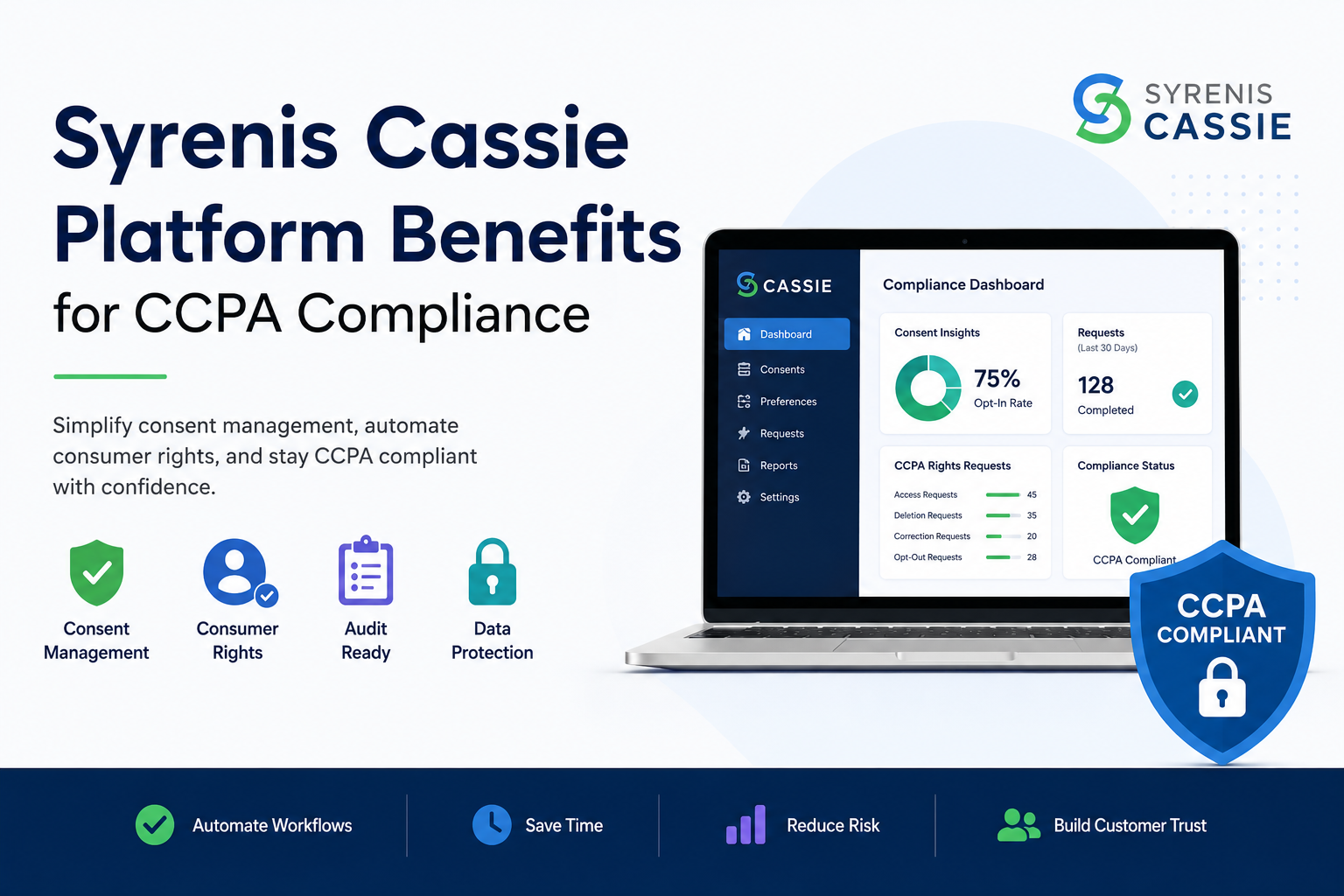
The Syrenis Cassie platform benefits for CCPA compliance come from its ability to automate consent management, data subject rights, privacy preferences, and compliance reporting within a centralized platform. Instead of relying on spreadsheets and disconnected workflows, organizations can use Cassie to demonstrate accountability while reducing operational risk.
If your business collects personal information from California residents, complying with the California Consumer Privacy Act (CCPA) requires more than publishing a privacy policy. You must manage consumer requests, document consent where applicable, maintain audit records, and respond within legal deadlines. This guide explains how the Syrenis Cassie platform supports those requirements, the business benefits it provides, implementation considerations, and best practices for organizations operating in the United States, the United Kingdom, and other global markets.
What Is the Syrenis Cassie Platform?
Direct answer: The Syrenis Cassie platform is a consent and preference management platform that helps organizations collect, manage, synchronize, and govern customer permissions across multiple systems while supporting privacy regulations including CCPA and GDPR.
Originally developed to solve enterprise consent management challenges, Cassie has evolved into a centralized privacy preference platform used across industries such as healthcare, financial services, telecommunications, government, and retail.
Core platform capabilities
The platform typically includes:
- Consent management
- Preference management
- Data subject request support
- Audit logging
- API integrations
- Customer communication preferences
- Privacy policy version tracking
- Workflow automation
Unlike traditional CRM systems that simply store customer records, Cassie focuses on maintaining an accurate history of customer permissions and privacy choices.
Real-world example
A healthcare provider collects patient communication preferences through its website, mobile app, and customer service center. Cassie synchronizes these preferences across all channels, ensuring that patients receive only communications they have authorized while maintaining a complete audit history.
How Does Syrenis Cassie Help Achieve CCPA Compliance?
Direct answer: Syrenis Cassie helps organizations satisfy key operational requirements of the CCPA by centralizing privacy preferences, automating consumer rights workflows, and maintaining verifiable compliance records.
CCPA requires businesses to respect consumer privacy rights, including access, deletion, correction, and opt-out requests. Managing these requests manually becomes increasingly difficult as organizations grow.
Centralized privacy management
Instead of storing consent information in multiple systems, Cassie creates a unified source of truth.
Benefits include:
- Consistent privacy preferences
- Reduced duplicate records
- Faster request processing
- Better data governance
Consumer rights management
Organizations can better manage requests relating to:
- Right to Know
- Right to Delete
- Right to Correct
- Right to Opt-Out
- Sensitive Personal Information limitations
Although additional internal workflows may still be required, centralized request management significantly reduces administrative burden.
Audit readiness
One of the biggest compliance advantages is maintaining comprehensive records.
Cassie can help document:
- When consent was given
- How consent was obtained
- Which privacy notice applied
- Preference changes
- User identity verification
- Request completion history
If regulators investigate a complaint, having detailed records can substantially reduce compliance risk.
Example
A retail company receives 500 deletion requests after a marketing campaign. Rather than manually tracking each request, Cassie automates request routing, updates connected systems, and records every action for future audits.
What Are the Biggest Syrenis Cassie Platform Benefits for CCPA Compliance?
Direct answer: The primary benefits include automation, reduced compliance risk, centralized consent management, improved customer trust, operational efficiency, and stronger audit capabilities.
Reduced manual workload
Privacy teams often spend significant time managing:
- spreadsheets
- email requests
- consent records
- customer preferences
Automation dramatically reduces repetitive administrative work.
Improved compliance consistency
Manual processes often produce inconsistent results.
Automation helps ensure:
- standardized workflows
- consistent responses
- documented approvals
- repeatable processes
Better customer experience
Consumers increasingly expect businesses to respect privacy choices.
Cassie enables:
- self-service preference centers
- faster request fulfillment
- accurate communication preferences
- fewer unwanted marketing messages
Stronger audit trails
Every privacy decision becomes traceable.
Organizations can quickly demonstrate:
- who made a request
- when changes occurred
- which systems were updated
- completion timelines
Enterprise scalability
As businesses expand internationally, managing privacy across multiple regulations becomes more complex.
Cassie supports organizations operating under multiple frameworks, including:
| Capability | Business Benefit |
| Central consent repository | Single source of truth |
| API integrations | Faster synchronization |
| Workflow automation | Lower operating costs |
| Audit logging | Easier regulatory reporting |
| Preference management | Better customer experience |
| Multi-channel support | Consistent compliance |
Example
A multinational software company expands into California while already complying with GDPR. Rather than deploying separate privacy systems, it uses Cassie to manage customer preferences across both regulatory environments.
How Does Cassie Compare with Manual CCPA Compliance Processes?
Direct answer: Manual compliance can work for small organizations, but enterprise businesses usually benefit from automation as request volumes, data sources, and regulatory obligations increase.
| Feature | Manual Process | Syrenis Cassie |
| Consent tracking | Spreadsheet | Automated |
| Audit logs | Limited | Comprehensive |
| Customer preferences | Separate systems | Centralized |
| DSAR management | Manual | Workflow-based |
| Reporting | Time-consuming | Automated |
| Integration | Minimal | Extensive APIs |
| Scalability | Limited | Enterprise-ready |
When manual processes may be sufficient
Manual workflows may work if:
- fewer than 1,000 customer records
- limited online operations
- low privacy request volume
When automation becomes valuable
Automation is usually worthwhile when:
- operating in multiple countries
- managing millions of customer records
- processing frequent privacy requests
- integrating multiple business applications
What Should Organizations Consider Before Implementing Syrenis Cassie?
Direct answer: Successful implementation depends on understanding your data landscape, defining governance responsibilities, and integrating Cassie with existing business systems.
Step 1. Map your personal data
Identify:
- customer databases
- CRM systems
- marketing platforms
- mobile applications
- websites
- support systems
Step 2. Define privacy workflows
Determine:
- approval processes
- request verification
- deletion procedures
- escalation paths
Step 3. Integrate business systems
Connect:
- CRM
- ERP
- Marketing automation
- Identity management
- Customer portals
Step 4. Train employees
Privacy compliance depends on people as much as technology.
Training should include:
- request handling
- consumer rights
- security procedures
- escalation processes
Step 5. Monitor and improve
Compliance is an ongoing process.
Review regularly:
- response times
- audit logs
- policy updates
- integration health
Example
A financial services company initially struggled with inconsistent customer communication preferences across five separate applications. After integrating Cassie, preference synchronization became automatic, significantly reducing customer complaints.
Can Syrenis Cassie Support Other Privacy Regulations Besides CCPA?
Direct answer: Yes. One of Cassie’s strengths is supporting organizations operating under multiple privacy regulations through centralized preference and consent management.
Many businesses must comply with several laws simultaneously.
Examples include:
- GDPR
- UK GDPR
- PECR
- LGPD
- POPIA
- Quebec Law 25
- Australia’s Privacy Act
- Various U.S. state privacy laws
Using one platform across multiple jurisdictions helps reduce operational complexity while improving governance.
Organizations should still review jurisdiction-specific legal requirements because no software alone guarantees compliance.
Frequently Asked Questions
Q: Does Syrenis Cassie guarantee CCPA compliance?
A: No. No software can guarantee legal compliance by itself. Cassie supports compliance by automating consent management, privacy workflows, audit logging, and consumer request handling, but organizations must also implement appropriate policies, governance, and legal oversight.
Q: Is Syrenis Cassie suitable for small businesses?
A: It can be, although the platform is generally designed for organizations with more complex privacy requirements. Smaller businesses should evaluate implementation costs, request volume, and integration needs before selecting an enterprise platform.
Q: How does Cassie improve audit readiness?
A: Cassie maintains detailed records of consent, preference updates, policy versions, user actions, and request processing. These records help organizations demonstrate accountability during internal reviews or regulatory investigations.
Q: Can Cassie integrate with existing CRM systems?
A: Yes. The platform supports API-based integrations with many enterprise applications, allowing customer preferences to synchronize across marketing, customer service, and operational systems.
Q: Does Cassie support GDPR as well as CCPA?
A: Yes. Many organizations use Cassie to manage privacy preferences across multiple regulatory frameworks, including GDPR, UK GDPR, and other international privacy laws.
Q: Why is centralized consent management important?
A: Centralized consent management reduces inconsistent customer records, improves privacy governance, simplifies audits, and ensures every department follows the same customer privacy preferences.
Conclusion
The Syrenis Cassie platform benefits for CCPA compliance extend far beyond consent collection. The platform helps organizations centralize privacy management, automate consumer rights workflows, and maintain detailed audit records that support regulatory accountability.
Three key takeaways stand out. First, centralized consent and preference management reduces compliance risk and operational complexity. Second, automation enables faster, more consistent responses to consumer requests while improving the customer experience. Third, comprehensive audit trails strengthen governance and make it easier to demonstrate compliance during reviews or investigations.
If your organization is evaluating privacy management solutions, start by assessing your current data flows, compliance obligations, and integration requirements. Choosing a platform that aligns with both your regulatory needs and long-term business growth can help build a more resilient privacy program.
Disclaimer: This article is for informational purposes only and does not constitute legal advice. Organizations should consult qualified privacy counsel regarding compliance with applicable privacy laws.
