


Most people use the phrase “industry” and “business vertical” interchangeably. They’re not the same thing — and that distinction can quietly cost you in marketing, sales targeting, and product positioning.
If you’ve ever struggled to define what market your business truly serves, or tried to segment customers and hit a wall, the problem is often a missing framework. Business vertical classification categories solve exactly that.
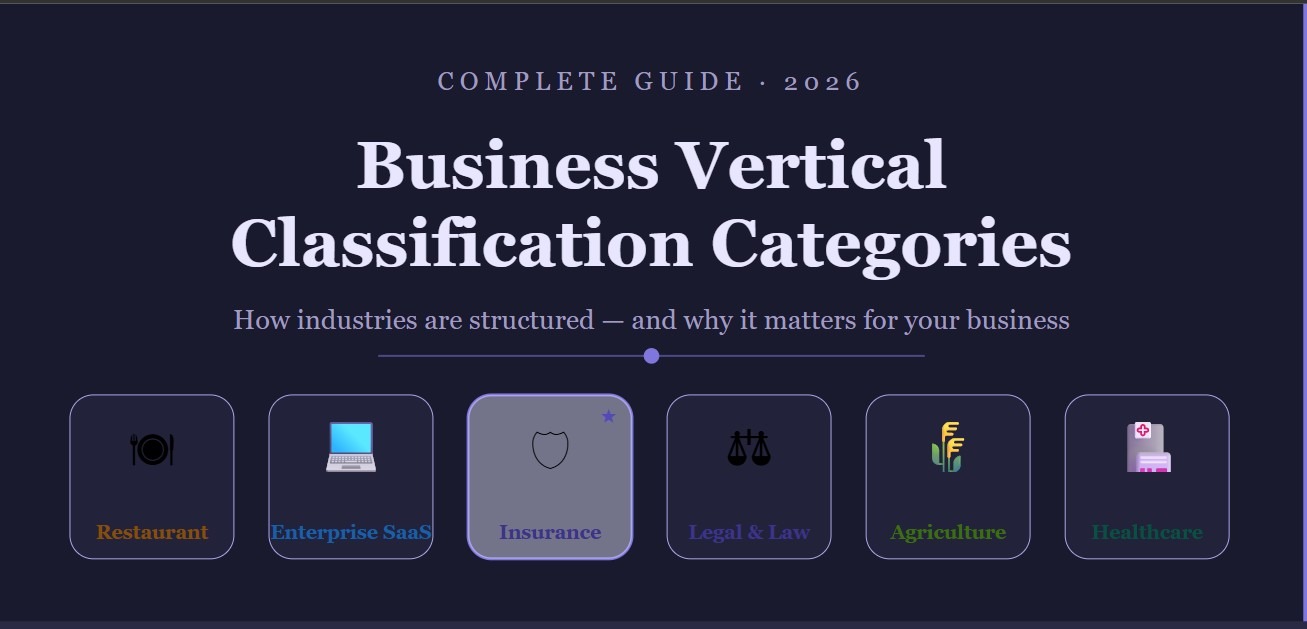
This guide breaks down every major vertical, explains how classification works in practice, and shows you how companies like SaaS platforms, law firms, restaurants, insurance providers, and agribusinesses apply vertical thinking to grow faster and serve clients better.
Quick Answer: Business vertical classification categories are structured groupings of companies that operate within a specific industry segment and share common customers, regulations, workflows, and needs. Common verticals include healthcare, legal, financial services, agriculture, hospitality, enterprise software, retail, and real estate. Businesses use vertical classification to focus marketing, product development, and sales strategies on the most relevant buyer segments.
Table of Contents
What Is a Business Vertical?
A business vertical — also called a vertical market or industry vertical — is a group of companies that focus on a specific niche of customers or a narrow set of related needs. Unlike broad horizontal markets, verticals are defined by who they serve, not just what they sell.
Definition box:
A business vertical classification category is a structured segment of the economy where companies share a common customer base, regulatory environment, operational model, and problem set. Examples include healthcare, legal services, agriculture, financial services, and hospitality.
The term comes from thinking about a market as a vertical column: deep expertise, specialized solutions, tight audience focus. A horizontal market, by contrast, is wide and shallow — think office supplies or cloud storage, which serve every industry.
Vertical vs. Horizontal: What’s the Real Difference?
Understanding this distinction is foundational before diving into specific categories.
| Feature | Vertical Market | Horizontal Market |
| Customer focus | Narrow, industry-specific | Broad, cross-industry |
| Product customization | High | Low |
| Competition | Specialized players | Mass-market giants |
| Sales cycle | Longer, trust-based | Shorter, transactional |
| Pricing power | Higher (expertise premium) | Commoditized |
| Examples | Legal software, AgriTech | Email tools, cloud storage |
Companies that go vertical typically achieve higher customer retention, stronger brand authority, and better word-of-mouth within that segment. The trade-off is a smaller total addressable market — at least initially.
The Major Business Vertical Classification Categories
There is no single universal standard, but the most widely used frameworks — including NAICS (North American Industry Classification System), SIC codes, and GICS (Global Industry Classification Standard) — all converge on a similar set of core verticals.
Here are the primary business vertical classification categories recognized globally:
Goods-Producing Verticals:
- Agriculture, Forestry, Fishing, and Hunting
- Mining, Oil, and Gas Extraction
- Construction
- Manufacturing (discrete and process)
Service-Producing Verticals:
- Retail and E-commerce
- Wholesale Trade
- Transportation and Logistics
- Information Technology and Telecommunications
- Financial Services, Insurance, and Real Estate (FIRE sector)
- Professional, Scientific, and Technical Services (includes legal)
- Healthcare and Social Assistance
- Hospitality, Food Services, and Tourism
- Education and Training
- Government and Public Administration
Emerging and Hybrid Verticals:
- CleanTech and Sustainability
- Legal Technology (LegalTech)
- AgriTech
- FinTech and InsurTech
- HealthTech and Telehealth
- PropTech (Property Technology)
Each of these broad verticals contains sub-verticals. Healthcare, for example, breaks into acute care, long-term care, behavioral health, pharmaceutical distribution, and medical devices — each with distinct buyer personas, compliance requirements, and purchasing cycles.
Deep Dive: Restaurant & Hospitality Business Vertical
The restaurant and food service vertical is one of the most dynamic and operationally complex categories in the business world.
What defines this vertical?
Companies in the restaurant business vertical share a common operational profile: high labor intensity, perishable inventory, thin margins, and direct consumer relationships. The vertical includes:
- Full-service and fast-casual restaurants
- Quick-service (QSR) chains and franchises
- Catering and event food services
- Cloud kitchens and ghost kitchens
- Food delivery platforms (B2B infrastructure layer)
- Beverage brands (coffee chains, craft breweries)
Key classification sub-categories:
Restaurants are further classified by service format (full-service, limited-service), cuisine type, ownership model (franchise vs. independent), and revenue tier. The U.S. Census Bureau and the National Restaurant Association both use NAICS code 722 for food services and drinking places.
Real-world example:
A POS software company that targets restaurants specifically — versus one that targets all retail — is operating vertically. It can build features for table management, split checks, and kitchen display systems that a generic POS never would. That specialization becomes a durable competitive advantage.
Why this vertical matters to vendors:
Food service businesses spend heavily on inventory management, payroll, loyalty software, and payment processing. Understanding that this is a separate vertical — not just “retail with food” — changes everything about how you pitch, price, and support these clients.
Deep Dive: Enterprise Software (SaaS) Business Vertical
The enterprise software vertical is technically a horizontal enabler — software can serve every industry — but it has evolved into one of the most segmented verticals in existence.
What defines this vertical?
Enterprise software companies are classified by:
- Deployment model: Cloud (SaaS), on-premise, hybrid
- Function: ERP, CRM, HCM, SCM, business intelligence
- Customer size: SMB, mid-market, enterprise
- Vertical specialization: Healthcare software, legal software, construction ERP, etc.
The vertical-within-vertical problem:
This is where classification gets nuanced. A company like Veeva Systems is technically in the enterprise software vertical — but it serves only life sciences companies. It is simultaneously classified under enterprise software AND healthcare/pharma. This dual-vertical positioning is increasingly common and represents a strategic choice.
Key sub-classifications:
- Core business applications (ERP, CRM, HCM)
- Infrastructure software (cybersecurity, cloud platforms)
- Vertical SaaS (purpose-built for one industry)
- Horizontal SaaS (productivity, communication, finance tools)
The rise of vertical SaaS — software built specifically for restaurants, law firms, construction companies, or farms — is one of the defining trends reshaping this classification category.
Deep Dive: Insurance Business Vertical
The insurance vertical sits at the intersection of financial services and risk management. It is one of the most heavily regulated and data-intensive verticals globally.
Core classification categories in insurance:
By product line:
- Property and Casualty (P&C): auto, home, commercial property
- Life and Annuities
- Health Insurance
- Specialty Lines: marine, aviation, cyber, professional liability
By distribution model:
- Direct carriers (sell directly to consumers)
- Independent agents and brokers
- Managing General Agents (MGAs)
- Reinsurers (insure the insurers)
By technology layer (InsurTech):
- Policy management platforms
- Claims automation
- Telematics and IoT-driven underwriting
- Digital distribution and embedded insurance
Why precise classification matters in insurance:
A marketing automation tool built for P&C insurance brokers has fundamentally different requirements than one built for life insurance carriers. Workflow, compliance language, lead types, and customer lifecycle stages all differ. Vertical classification guides every product and sales decision.
Deep Dive: Law Firm & Legal Services Vertical
Law firms and legal service providers form a distinct vertical with unique characteristics: billable-hour economics, strict confidentiality requirements, and a buyer persona (the attorney or general counsel) unlike almost any other.
Legal vertical classification sub-categories:
By firm type:
- Am Law 100 and large firm practices
- Boutique and specialty firms
- Solo practitioners
- In-house legal departments (corporate)
- Alternative Legal Service Providers (ALSPs)
By practice area:
- Corporate and M&A
- Litigation and dispute resolution
- Real estate and land use
- Intellectual property
- Employment and labor
- Criminal defense and family law
By technology maturity:
- Traditional (paper-heavy, billing-focused)
- Transitional (adopting cloud tools)
- Tech-forward (AI-powered legal research, contract automation)
Real-world example:
Clio, a legal practice management platform, built its entire business by treating law firms as a distinct vertical — not as “professional services.” That focus let it build features like trust accounting, court calendar syncing, and matter-specific billing that a generic project management tool would never include. The company reached unicorn status by going deep in one vertical.
Deep Dive: Agricultural Business Vertical
Agriculture is one of the oldest and most foundational business verticals — and also one of the fastest-changing, thanks to precision farming, satellite data, and supply chain technology.
Agricultural vertical classification categories:
By activity type:
- Crop production (row crops, specialty crops, horticulture)
- Livestock and poultry production
- Aquaculture and fisheries
- Forestry and timber
- Agricultural support services (custom harvesting, soil testing)
By value chain position:
- Input suppliers (seed, fertilizer, pesticides, equipment)
- Producers (farms and ranches)
- Processors and manufacturers (food and fiber)
- Distributors and logistics providers
- Retailers and exporters
By technology integration (AgriTech sub-vertical):
- Precision agriculture (GPS, drones, satellite imagery)
- Farm management software
- Vertical and indoor farming
- Agricultural biotech and genomics
- Commodity trading and risk management platforms
Why classification matters in agriculture:
A lender serving row crop farmers in the Midwest needs completely different underwriting models, seasonal cash flow profiles, and risk indicators than one serving greenhouse operators or livestock producers. The agricultural vertical is not monolithic — classification at the sub-vertical level is what makes financial products, insurance policies, and software actually useful to farmers.
How Businesses Use Vertical Classification Strategically
Understanding business vertical classification is not just academic. It drives real decisions:
1. Go-to-market strategy: Vertical focus lets sales teams build deep domain expertise and speak the language of the buyer. A rep who knows the restaurant business can discuss food costs, table turns, and tip pooling — and that credibility closes deals.
2. Product roadmap prioritization: When you know your vertical, you know which compliance requirements, integrations, and workflows to build first.
3. Content marketing and SEO: Vertical-specific content — “how restaurants manage inventory” vs. “how businesses manage inventory” — ranks better, converts better, and builds topical authority faster.
4. Pricing and packaging: Verticals with high regulatory burden (insurance, legal, healthcare) typically command premium pricing for compliance-ready features.
5. Partnership and channel strategy: Vertical classification tells you which trade associations, conferences, and media outlets your buyers trust — and where to show up.
Common Business Vertical Classification Mistakes to Avoid
Even experienced operators get this wrong. Watch out for:
- Conflating vertical with company size. “Enterprise” is a customer size segment, not a vertical. Enterprise healthcare and enterprise agriculture are completely different markets.
- Over-segmenting too early. A startup targeting “independent Italian restaurants with fewer than 10 employees in the Southeast” may be too narrow to build a scalable business.
- Under-segmenting at scale. Calling your market “all businesses” is the horizontal trap. The most funded, fastest-growing companies in the last decade have almost all been vertical specialists.
- Ignoring emerging sub-verticals. InsurTech, AgriTech, LegalTech, and PropTech started as niches. They’re now distinct investment categories attracting billions annually.
FAQ
Q: What is the difference between a business vertical and an industry? A: An industry is a broad economic category (e.g., healthcare). A business vertical is a more focused market segment within or across industries, defined by a shared customer type, problem set, or workflow. A vertical is always precise; an industry can be very wide.
Q: How many business vertical classification categories are there? A: The NAICS system defines 20 top-level sectors, but in practice, businesses typically work with 10–15 major verticals and dozens of sub-verticals. The number depends on the level of granularity needed for your specific use case.
Q: What vertical does a SaaS company belong to? A: A SaaS company can be classified under the Information Technology vertical for general purposes, but many SaaS products are better classified under the vertical they serve — a SaaS tool built for law firms is often considered part of the legal technology vertical.
Q: Why do banks and investors use vertical classification? A: Lenders and investors use vertical classification to assess industry-specific risk, benchmark financial performance against peers, and apply the right underwriting or valuation models. A restaurant business and a software business have completely different cost structures, margins, and failure rates.
Q: Is the restaurant industry a separate vertical from hospitality? A: Yes, in most classification frameworks. Restaurants (NAICS 722) are classified separately from hotels and accommodations (NAICS 721). They share some overlap in the broader “leisure and hospitality” super-sector but are operationally distinct.
Q: How does vertical classification affect SEO and content strategy? A: Vertical-specific content addresses the exact language, concerns, and questions of a defined buyer audience. This improves search relevance, reduces bounce rate, and builds topical authority — all of which are positive ranking signals.
Conclusion
Business vertical classification categories are the foundation of smart market positioning. Whether you’re launching a product, building a sales motion, writing content, or seeking investment, knowing your vertical — and defining it precisely — changes the quality of every decision that follows.
The major categories covered here — restaurant and hospitality, enterprise software, insurance, legal services, and agriculture — each operate by their own rules, serve distinct buyer types, and require specialized solutions. The companies that recognize this, and build accordingly, consistently outperform those chasing broad horizontal markets.
If your business currently serves “everyone,” start with the vertical classification framework above, identify the one or two segments where you already have the most traction, and go deep. That’s where durable competitive advantage lives. Ready to define your vertical and build a market strategy around it? Start by mapping your current customers against the classification categories above — the pattern that emerges will tell you exactly where to focus.
