


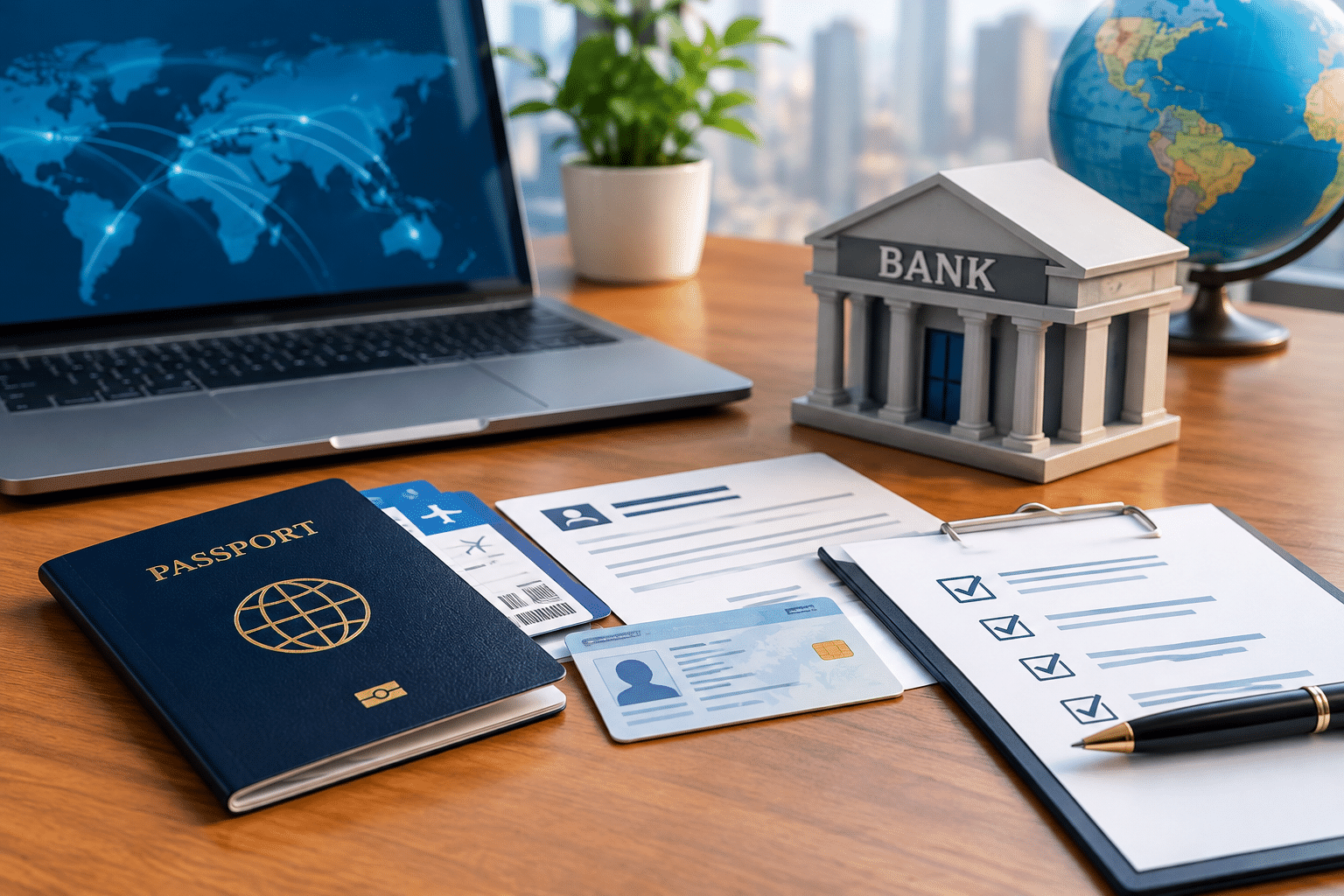
Opening a business bank account as a non resident is usually less about finding a single special form and more about proving three things clearly: who you are, what your company is, and where the money comes from and goes.
The documents for a non resident business bank account vary by country, bank, business structure, ownership and risk profile. There is no universal document list that every bank or financial institution follows. However, most applications revolve around the same core areas: identity, company registration, ownership, business address, authority to operate the account, business activity, tax information and source of funds.
This guide explains the business bank account documents you are most likely to encounter, why banks request them, what can cause an application to be delayed, and how to prepare a document pack that is easier for a compliance team to review.
Important: Requirements differ between banks, countries and regulated financial institutions. A document accepted by one provider may not be accepted by another. Always confirm the current requirements directly with the institution before submitting sensitive documents.
What Documents Are Usually Needed for a Non Resident Business Bank Account?
A typical application can involve several groups of documents.
| Document group | Common examples | Why the institution asks |
| Personal identity | Passport, national identity document | To verify the people behind the account |
| Personal address | Utility bill, bank statement, government correspondence | To establish residential address |
| Company registration | Certificate of incorporation, registry extract | To confirm the company legally exists |
| Company constitution | Articles, memorandum, operating agreement | To understand how the entity is structured |
| Ownership | Shareholder register, ownership chart | To identify who ultimately owns the company |
| Beneficial ownership | UBO declaration and supporting records | To identify the natural persons who control or own the business |
| Business address | Lease, utility bill, official registry record | To establish where the business is registered or operates |
| Authority | Board resolution, power of attorney, authorization letter | To establish who is allowed to open and operate the account |
| Business activity | Website, business plan, contracts, invoices | To understand what the company actually does |
| Source of funds | Bank statements, contracts, sale agreements, loan documents | To establish where account funds originate |
| Tax information | Tax identification number, tax residence, FATCA or CRS forms | To meet tax reporting and account classification requirements |
| Licences | Regulatory or trade licences | To confirm the business is permitted to conduct regulated activities |
Financial institutions do not necessarily request all of these documents from every applicant. Wise, for example, says business verification can involve registration documents, business address evidence, ownership documents and personal identification, while the information requested varies by country and company type.
Why Do Banks Ask for So Many Documents?
A bank is not simply deciding whether to give a company an account.
It needs to understand the customer and the expected activity associated with the account.
International banking involves regulatory requirements covering areas such as:
- Customer identification
- Beneficial ownership
- Anti money laundering controls
- Sanctions compliance
- Tax reporting
- Transaction monitoring
- Risk assessment
The Financial Action Task Force recommends that financial institutions identify and verify customers, understand beneficial ownership, understand the purpose and intended nature of the relationship, and monitor transactions in light of the customer’s business and risk profile, including source of funds where appropriate.
In the United States, FinCEN’s customer due diligence framework similarly requires covered financial institutions to understand the nature and purpose of customer relationships and identify and verify beneficial owners of applicable legal entity customers.
That is why your application may contain questions that initially feel unrelated to simply opening a bank account.
They are usually part of the institution’s KYC and customer due diligence process.
1. What Personal Identification Documents Do You Need?
The first document most non resident founders should expect to provide is a valid government issued identity document.
For international applicants, this is commonly:
A valid passport
The institution may also request:
- National identity card
- Residence permit
- Other government issued identification
The exact combination depends on where you live, your nationality and the institution’s onboarding rules.
For example, Wise says it commonly verifies the account administrator and beneficial owners using personal identification, with additional requirements depending on the business and country.
Why is personal identification required?
The bank needs to establish that:
- You are a real person
- The identity document is valid
- You are the person claiming to represent the company
- The information matches the application
- You are not subject to relevant restrictions or sanctions
FinCEN’s guidance states that covered financial institutions must obtain identifying information for applicable beneficial owners, including the person’s name, date of birth, address and government identification information.
Practical advice
Make sure your passport name matches the name you enter on the application.
Small inconsistencies can create unnecessary questions.
For example:
Passport: Muhammad Ahmed Khan
Application: M. Ahmed Khan
That difference may look harmless to you, but compliance teams may ask for clarification.
2. What Proof of Residential Address Is Required?
Non resident business banking usually involves verifying the personal residential address of the owner, director, account administrator or other relevant person.
Common documents can include:
- Utility bill
- Bank statement
- Government correspondence
- Tax document
- Valid driving licence where accepted
- Residence document
The document usually needs to show:
- Your full name
- Your residential address
- A recent issue date
- The issuing organization
The acceptable age of the document varies.
For example, Wise says certain business address documents such as utility bills and bank statements generally need to be recent and specifies different validity periods for different document types.
Some institutions can impose stricter requirements.
HSBC UK states that documentation requirements for non UK customers can include current identification and recent certified proof of address, with the exact requirements depending on the applicant.
Important distinction
A registered company address is not necessarily the same thing as your personal residential address.
Banks may want both.
3. What Company Registration Documents Do You Need?
The next major category is evidence that the business legally exists.
Depending on the jurisdiction and entity type, this can include:
- Certificate of incorporation
- Company registration certificate
- Official registry extract
- Business registration certificate
- Articles of association
- Memorandum
- Operating agreement
- Partnership agreement
- Certificate of incumbency
- Register of directors
The document tells the financial institution important facts such as:
- Legal company name
- Registration number
- Date of incorporation
- Registered jurisdiction
- Legal status
- Registered address
Wise specifically lists certificates of incorporation, articles of association and official registry extracts among documents that may be requested during business verification.
Why does this matter for a non resident?
If the company is incorporated in one country while the owner lives in another, the institution has to understand the connection between:
Company jurisdiction
Owner residence
Management location
Account location
A clear corporate document helps establish the first part of that chain.
4. What Documents Prove Who Owns the Company?
This is one of the most important parts of a non resident business banking application.
Banks generally need to understand who ultimately owns or controls the company.
This is known as beneficial ownership.
Possible documents include:
- Shareholder register
- Ownership register
- Cap table
- Certificate of incumbency
- Corporate registry extract
- Ownership declaration
- Corporate structure chart
- Partnership agreement
- Trust documents where relevant
FinCEN’s CDD rules require covered U.S. financial institutions to identify and verify applicable beneficial owners of legal entity customers.
FATF guidance similarly emphasizes understanding the ownership and control structure of a legal person.
Why a simple company certificate may not be enough
Imagine this structure:
Company A
owned by
Company B
owned by
Company C
owned by
Individual D
The bank is interested in understanding who ultimately controls the structure.
That means you may need to provide documents for more than the immediate shareholder.
5. What Is a UBO and What Proof Is Needed?
UBO means Ultimate Beneficial Owner.
The exact legal definition and threshold can vary by jurisdiction and institution, but generally the bank wants to identify the natural persons who ultimately own or control the business.
For a simple company owned by one individual, the process may be straightforward.
For a multi layer corporate structure, it becomes more involved.
You may be asked for:
- Ownership chart
- Share register
- Corporate registry records
- Identification of individual owners
- Proof of ownership through intermediary companies
- Beneficial owner declaration
Wise, for example, says it may request details of individuals who directly or indirectly own 25 percent or more of a company or exercise control, together with supporting identification.
That 25 percent threshold is an example of one provider’s approach and a U.S. regulatory concept in certain contexts, not a universal global rule.
This distinction is important.
Never assume every bank uses exactly the same ownership threshold.
6. What Proof of Business Address Is Needed?
A bank may ask for evidence of where the business is registered or actually operating.
There can be two different concepts:
Registered address
The official address recorded by the company registry.
Trading or operating address
Where the business actually conducts its day to day activities.
These addresses can be the same, but they do not have to be.
Wise explicitly distinguishes between registered and trading addresses and may request documentation proving the business’s physical trading address.
Possible supporting documents include:
- Lease agreement
- Utility bill
- Business licence
- Official tax document
- Bank statement
- Government correspondence
- Registration document
Why does the physical location matter?
A bank may want to understand whether the company is a genuine operating business or simply a legal entity established without meaningful activity.
That does not mean every legitimate company must maintain a large office.
It means the bank may need to understand where the business actually operates.
7. What If You Use a Virtual Office?
This is an important issue for internationally owned companies.
A registered office may be provided by:
- Company formation agent
- Corporate service provider
- Accountant
- Lawyer
- Registered office provider
But that address may not represent the company’s actual operational location.
Some financial institutions distinguish sharply between:
Registered address
and
Physical trading address.
Wise, for example, says that its trading address requirements may exclude virtual offices, mail forwarding addresses and registration agency addresses.
That is a provider specific rule, not a universal banking rule.
The lesson is more important:
Do not assume that a registered office automatically satisfies every institution’s business address requirement.
8. What Documents Prove Your Authority to Open the Account?
The bank needs to know whether the person submitting the application is authorized to act for the company.
Depending on the business structure, this may be shown through:
- Director status
- Company registry information
- Board resolution
- Corporate authorization
- Power of attorney
- Authorization letter
This becomes especially important when:
The applicant is not a director.
Wise says that someone who is not a director may need evidence of authority such as an authorization letter, power of attorney or board resolution.
A bank may also ask for information about:
- Authorized signatories
- Directors
- Account administrators
- Individuals with payment authority
9. Do Banks Ask What Your Business Actually Does?
Yes. This is one of the most important parts of KYC.
You may be asked to explain:
- Products or services
- Customers
- Suppliers
- Countries where you operate
- Countries where customers are located
- Expected transaction volumes
- Payment currencies
- Purpose of the account
- How the account will be funded
Wise says businesses may need to provide information about their activities, website, intended use of the account and expected monthly transaction volumes.
HSBC similarly says business customers may be asked for information concerning business structure, beneficial ownership and countries where they do business.
Why does the bank ask?
Because it needs to determine whether the expected activity makes sense for the business.
For example:
A company says it expects monthly transactions of $20,000.
Then the application suddenly requests transaction capability for $20 million per month.
That inconsistency can trigger additional questions.
The objective is not simply to maximize the amount you can move.
It is to provide a credible explanation of how the account will actually be used.
10. What Is a Business Plan and When Might a Bank Request One?
A new company may not have:
- Annual accounts
- Historical bank statements
- Large customer contracts
- Previous trading records
That does not necessarily prevent an application.
However, the institution may want more evidence about the proposed business.
A business plan can explain:
- What the company sells
- Target customers
- Countries served
- Supplier relationships
- Expected revenue
- Expected payment flows
- Funding sources
- Growth plans
A good business plan does not need to be a fifty page document.
For account opening, a concise and specific explanation can be more useful than a generic investor presentation.
11. What Is Source of Funds and Why Do Banks Ask for It?
Source of funds means where the money entering the account comes from.
Examples include:
- Sales revenue
- Investment by shareholders
- Business loan
- Asset sale
- Investor funding
- Contract payments
- Transfer from an existing company account
The bank may ask you to demonstrate the origin of a particular amount of money.
The FCA explains that source of funds concerns the origin of the funds involved in the business relationship or transaction. Source of wealth concerns how a customer or beneficial owner accumulated their overall wealth.
These are related concepts but not the same thing.
Example
You tell the bank:
The company was funded with $100,000 by its owner.
The bank may then ask:
How did the owner obtain the $100,000?
That second question moves toward source of wealth.
12. What Documents Can Prove Source of Funds?
The exact evidence depends on the source.
| Source of funds | Possible evidence |
| Business revenue | Invoices, contracts, bank statements |
| Shareholder investment | Investment agreement, bank transfer records |
| Business loan | Loan agreement and funding evidence |
| Sale of an asset | Sale agreement and bank receipt |
| Investment funding | Investment documents and transfer records |
| Existing company funds | Previous bank statements and financial records |
| Property sale | Sale agreement and completion documentation |
Wise says it may request bank statements or annual statements to demonstrate business funding and may ask for loan agreements or contracts where funds come from financing.
HSBC also explains that banks may request documentation concerning the origin of a customer’s money.
13. Do You Need Tax Documents?
Possibly.
The institution may ask for:
- Tax identification number
- Tax residence information
- Tax residency self certification
- FATCA information
- CRS information
- U.S. tax forms where applicable
Under the OECD Common Reporting Standard, financial institutions collect information about an account holder’s tax residence and, where required, report relevant information through the applicable tax information exchange framework.
For certain foreign entities interacting with U.S. financial institutions, Form W 8BEN E can be relevant to document foreign status and FATCA classification. The IRS explains that the form can be requested from foreign entities maintaining accounts with financial institutions and is used for specified U.S. tax documentation purposes.
Do not complete a tax form simply because someone online says you need one.
The correct form depends on:
- Entity type
- Tax status
- Account location
- Transaction type
- Applicable tax rules
14. Will a Bank Ask for Business Licences?
If your business operates in a regulated sector, this becomes much more likely.
Examples include:
- Financial services
- Payments
- Insurance
- Investment
- Healthcare
- Pharmaceuticals
- Gambling
- Certain import and export activities
- Money services
- Professional activities requiring licensing
The bank may ask for:
- Business licence
- Regulatory registration
- Permit
- Professional certificate
- Regulator authorization
The purpose is straightforward:
The institution wants to understand whether the business is legally allowed to conduct the activity it says it conducts.
15. Will Banks Ask for Contracts and Invoices?
They can.
This is especially common when the bank needs to understand:
- Customer relationships
- Supplier relationships
- Expected payment flows
- Commercial purpose
- Source of funds
A new company may have limited trading history.
A signed contract with a genuine customer can sometimes provide useful evidence of the company’s intended activity.
An invoice may help demonstrate:
- What was sold
- Who the customer is
- Amount
- Currency
- Commercial purpose
However, never create documents just to satisfy a bank.
False or misleading documents can create much more serious problems than an incomplete application.
16. Can Banks Ask for a Board Resolution?
Yes.
A board resolution can be used to demonstrate that the company has formally authorized:
- Opening a bank account
- Appointing account signatories
- Giving authority to specific individuals
- Using specified banking services
Requirements differ according to entity type and institution.
A published DBS account opening checklist, for example, includes board or partner resolutions, constitutional documents, identity records, proof of residential address and beneficial ownership information for certain business structures. It also gives additional requirements for foreign incorporated companies.
This is a useful illustration of how detailed a bank document pack can become.
It should not be treated as a universal checklist for every country.
17. Do Documents Need to Be Certified or Notarized?
Sometimes.
This depends on:
- Country
- Bank
- Document type
- Applicant location
- Ownership complexity
- Risk assessment
- Whether the document can be independently verified
Possible requirements include:
- Original documents
- Certified copies
- Notarized documents
- Apostilled documents
- Certified translations
Some institutions require documents to be in a specific language or require a certified translation.
For example, HSBC UK states that some non UK customers may be asked for certified identification and address documents and notes requirements concerning certification and translation.
A published DBS corporate account checklist similarly describes situations where foreign incorporated company documents may need to be originals or certified true copies.
Practical rule
Do not notarize every document before you know the bank’s requirements.
That can create unnecessary expense.
First obtain the institution’s document checklist.
Then certify only the documents that actually require certification.
18. What If Your Documents Are Not in English?
This is another issue for international founders.
A bank may accept documents in the local language.
Another institution may require:
Certified translation
Some institutions may accept multilingual official documents.
Others may require both:
- Original document
- Certified translation
Never assume English is mandatory everywhere.
But if the bank tells you that a translation is required, follow its exact requirements.
19. What Should a New Company Prepare if It Has No Banking History?
This is one of the most practical situations for a newly incorporated company.
You may not have:
- Existing business bank statements
- Long trading history
- Audited accounts
- Historical invoices
In that situation, prepare a stronger alternative package.
New company document pack
- Certificate of incorporation
- Constitutional documents
- Ownership structure
- UBO information
- Passport copies for relevant individuals
- Residential address evidence
- Business address evidence
- Website
- Business description
- Business plan
- Expected monthly transaction volume
- Expected countries and currencies
- Customer or supplier contracts if available
- Proof of initial funding
- Tax identification information
- Required tax residency forms
- Applicable business licences
- Board resolution or authorization
This gives the institution something much more useful than simply saying:
“The company is new.”
It explains what the company is, who owns it, how it will operate and where its initial money comes from.
20. What Documents Cause the Most Problems?
The biggest problems are often not missing documents.
They are inconsistent documents.
For example:
Company registry: ABC Trading Ltd
Bank application: ABC Trading Limited
Website: ABC Global Trading
Invoice: ABC International
Shareholder document: ABC Trading LTD
Some differences may be harmless.
Others can create questions.
Wise specifically identifies mismatches between submitted documents and account information as a common reason for address verification problems.
Check these details before applying
Make sure the following are consistent where applicable:
- Legal company name
- Registration number
- Registered address
- Trading address
- Director names
- Shareholder names
- Ownership percentages
- Passport names
- Business activity
- Website
- Expected transaction volume
- Country of residence
21. What Is the Best Way to Prepare Your Document Pack?
Do not upload files randomly.
Build a structured digital folder.
Folder 1: Company
- Certificate of incorporation
- Registry extract
- Articles
- Operating agreement
- Licences
Folder 2: Ownership
- Shareholder register
- Ownership chart
- UBO declaration
- Corporate shareholder documents
Folder 3: People
- Passport
- Proof of address
- Director information
- Authorized signatory information
Folder 4: Business Activity
- Website
- Business plan
- Contracts
- Invoices
- Supplier documents
Folder 5: Funds
- Bank statements
- Investment documents
- Loan agreements
- Sale agreements
- Other source of funds evidence
Folder 6: Tax
- Tax identification
- Tax residency information
- CRS documentation
- FATCA documentation where applicable
This makes it easier to respond when the compliance team asks for additional evidence.
What Should You Have Ready Before Applying?
Use this practical checklist.
| Area | Prepare |
| Personal identity | Valid passport or accepted government ID |
| Residential address | Recent acceptable address evidence |
| Company existence | Certificate and registry evidence |
| Company structure | Articles or equivalent |
| Ownership | Shareholder information and ownership chart |
| Beneficial owners | Identity and supporting ownership evidence |
| Directors | Names, residence and identification |
| Account authority | Board resolution, authorization or power of attorney where required |
| Business address | Registered and operating address evidence |
| Business activity | Website, description and business plan |
| Customers | Contracts or invoices where available |
| Suppliers | Contracts or commercial records where relevant |
| Source of funds | Bank statements and supporting funding documents |
| Tax | Tax number and applicable tax forms |
| Licences | Regulatory approvals where applicable |
| Translation | Certified translation if required |
| Certification | Certified copies if specifically requested |
Why Is a Strong Document Pack Important?
A strong application is not simply a large collection of documents.
It is a consistent story.
The bank should be able to understand:
Who owns the company?
↓
Where is the company registered?
↓
Where does it operate?
↓
What does it sell?
↓
Who are its customers?
↓
How does it make money?
↓
Where does the account money come from?
↓
Where will the money go?
↓
Why does the business need this account?
That is essentially what a good KYC process is trying to establish.
FATF standards specifically emphasize identifying the customer, understanding beneficial ownership, understanding the purpose and intended nature of the relationship and monitoring transactions against the customer’s business and risk profile.
Does Having All the Documents Guarantee Account Approval?
No.
This is extremely important.
A complete document package does not guarantee approval.
A bank can still decline an application after reviewing the documents.
The institution may consider factors such as:
- Business model
- Industry
- Countries involved
- Customer and supplier locations
- Ownership structure
- Sanctions exposure
- Expected transaction activity
- Source of funds
- Regulatory requirements
- Internal risk policies
HSBC, for example, states that information requested from business customers depends on the size and nature of the business and may include ownership, legal structure and countries of operation.
Your objective should therefore be:
Make the business easy for the compliance team to understand and verify.
Do not try to find a way around KYC.
Prepare for it.
What Is Different About U.S. Business Accounts?
U.S. institutions have their own customer due diligence requirements.
FinCEN states that covered financial institutions must identify and verify applicable beneficial owners of legal entity customers and understand the nature and purpose of the customer relationship.
In February 2026, FinCEN issued an exceptive relief order that allows covered financial institutions, at their discretion, to reduce the requirement to identify and verify beneficial owners at every subsequent account opening, subject to specified circumstances and risk based procedures. The relief does not remove the underlying need for financial institutions to understand beneficial ownership.
For a foreign entity dealing with a U.S. financial institution, tax documentation can also be relevant. For example, a foreign entity may be asked for Form W 8BEN E to document its foreign status and applicable FATCA classification.
That is why a U.S. account application should be treated as its own compliance exercise rather than assuming the same documents used for a UK, Singapore or UAE account will be enough.
Final Checklist: Documents for a Non Resident Business Bank Account
Before starting the application, prepare these documents where relevant:
Personal
- Passport
- Additional identity document if requested
- Residential address evidence
Company
- Certificate of incorporation
- Official company registry extract
- Articles or operating agreement
- Business licence if applicable
Ownership
- Shareholder register
- Ownership structure chart
- UBO declaration
- Supporting corporate ownership records
Management
- Director information
- Authorized signatory information
- Board resolution or authorization
- Power of attorney where applicable
Business
- Registered address evidence
- Trading address evidence
- Website
- Business description
- Business plan where appropriate
- Customer contracts
- Supplier contracts
- Invoices where available
Financial
- Existing business bank statements if available
- Source of funds evidence
- Source of wealth evidence where requested
- Loan or investment documents where applicable
Tax
- Tax identification number
- Tax residence information
- CRS self certification where required
- FATCA documentation where required
Additional
- Regulatory licences
- Certified copies where required
- Certified translations where required
You will not necessarily need all 34 items.
The list is deliberately broad because there is no universal document list for non resident business banking.
Frequently Asked Questions
What is the most important document for a non resident business bank account?
There is no single most important document. A valid company registration record, identity documentation, beneficial ownership information and a clear explanation of the business and its funds are usually central to the review.
Do non resident business owners need to provide a passport?
Often yes, but the institution determines which identity documents it accepts.
Do I need proof of residential address?
Many institutions request it for directors, owners, account administrators or authorized individuals.
Do I need proof of business address?
Often yes. The bank may distinguish between the registered company address and the place where the business actually operates.
Will the bank ask for proof of source of funds?
It can. Banks and regulated financial institutions may need to understand where business funds originate, particularly where transaction activity or risk warrants additional review.
Do I need a business plan?
Not always. A new company with little trading history may find a concise business plan useful when the institution needs more information about its expected activities.
Can I open an account with only a certificate of incorporation?
Usually, you should expect additional questions and documents. Incorporation proves that the entity exists, but it does not by itself explain ownership, identity, business activity or source of funds.
Can a virtual office be used as the business address?
Sometimes, but policies vary. Some financial institutions require evidence of a physical trading address and may not accept a virtual office as that address.
Do banks require certified copies?
Some do for particular applicants or documents. Others verify documents electronically or accept standard copies. Ask the institution before paying for certification.
Does having every required document guarantee approval?
No. Banks conduct their own risk assessment and can request additional information or decline applications.
Final Takeaway
The best way to approach a non resident business bank account application is to think beyond a simple document checklist.
A successful application needs to tell a consistent story:
You are who you say you are.
The company legally exists.
The ownership structure is transparent.
The person applying is authorized.
The business has a genuine commercial purpose.
The expected transactions make sense.
The money entering the account has a credible source.
The business understands its tax and regulatory obligations.
That is why the documents for a non resident business bank account can extend far beyond a passport and certificate of incorporation.
KYC is fundamentally about identity and customer understanding. Beneficial ownership documentation shows who controls the company. Business documents explain what the company does. Source of funds evidence explains where its money comes from. Tax information helps the institution classify and report the account correctly where required. FATF, FinCEN and financial institutions such as Wise and HSBC all reflect these principles in their customer due diligence processes.
The practical lesson is straightforward:
Do not prepare the smallest document package you can get away with. Prepare a clear, consistent and verifiable package that allows the institution to understand your company without repeatedly asking the same basic questions.
And remember one final point: a document checklist is not the same thing as an approval guarantee. Requirements vary by provider, jurisdiction and risk profile. The smartest approach is to obtain the current checklist from the institution you are applying to, prepare your core documents in advance, and make sure the information is consistent across your company records, website, contracts, tax records and application.
